
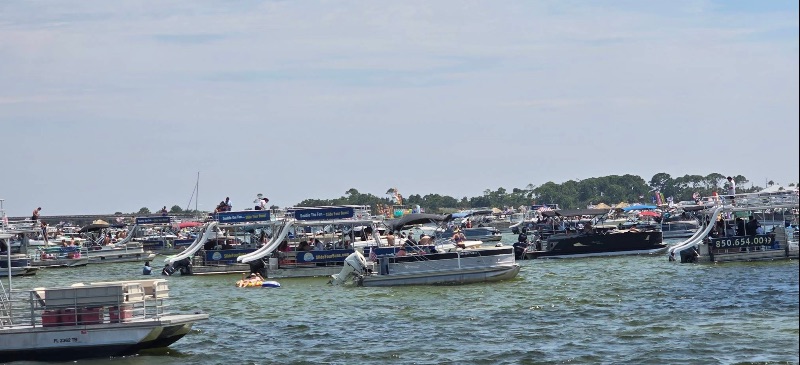
Lots of boats, lots of swimming, snorkeling, fishing, and simply fooling around in boats is a Florida tradition—and a good thing for fishing tackle producers, marine businesses, and coastal tourism. But in a growing number of places, the scale of those gatherings is starting to push past what the water, the infrastructure, and sometimes the people themselves can comfortably absorb.
On peak summer weekends, popular sandbars can draw hundreds—sometimes close to a thousand—boats packed bow-to-stern along shallow bars. That’s not hyperbole. Every open patch of sand or knee-deep water fills with boats, swimmers, coolers, floating mats, and marine stereos loud enough to qualify as mobile concert rigs. Alcohol is usually part of the scene, often in quantities that would raise eyebrows anywhere else.
I’m not anti-beer on a boat. But extended drinking in extreme heat, surrounded by hundreds of other boats doing the same thing, tends to produce predictable results—and not always good ones. Arguments over loud music, drifting anchors, public nudity, or simple bad manners sometimes turn into waterborne wrestling matches. When law enforcement arrives, citations and Boating Under the Influence arrests often follow.
Florida’s BUI laws mirror those on land, with one big exception: passengers may legally consume alcohol, but the operator may not be “under the influence.” In Florida, that’s a blood-alcohol content of .08 percent for operators 21 and older, and .02 percent for those under 21. In crowded sandbars, enforcement of that line has become a summer ritual.
Crab Island, just north of the U.S. 98 bridge in Destin, is the best-known example. Boca Grande’s version unfolds at Gasparilla Pass. Similar scenes play out at the Jupiter Sandbar, Peanut Island near Palm Beach, and Three-Rooker Bar off Tarpon Springs. These places have become modern Florida commons—part block party, part rite of summer—where freedom of assembly, public recreation, environmental limits, and public safety all collide.
The appeal is obvious. These areas sit in protected water, close to ramps and marinas, with shallow sand and clear water that’s perfect for kids and casual swimmers. They’re easy to reach and easy to enjoy—at Crab Island there are floating restaurants, and you can get out there via ferry service—you don’t even need a boat. But as social media amplifies their popularity, they’re being overwhelmed.
Open boats don’t have bathrooms. When thousands of people stand in the same shallow water for hours, basic biology comes into play. While tides eventually flush these areas, the nutrient load adds stress to already fragile systems. Trash is another unavoidable byproduct. Even if most boaters pack out what they bring, a small percentage of carelessness multiplied by hundreds of boats still leaves a mess that spreads with every tide.
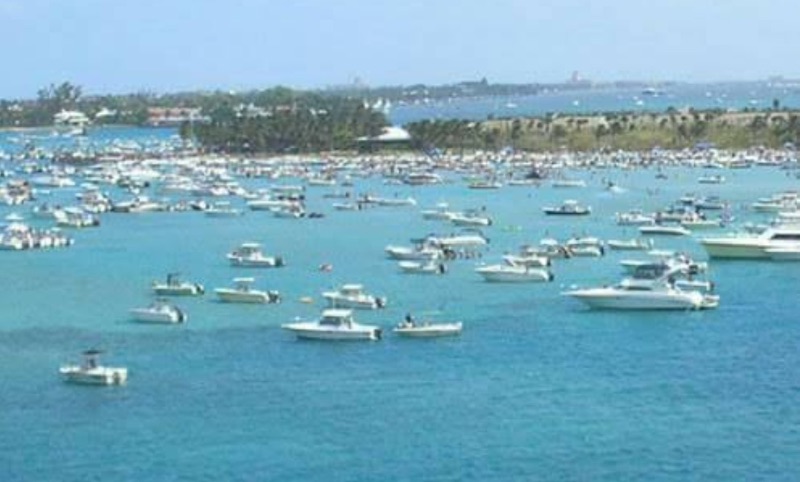
As the crowds have grown, so has friction. These floating neighborhoods mix families looking for a relaxed afternoon with party-oriented groups focused on volume—of music, alcohol, and attention. That clash has occasionally boiled over. In recent years, viral videos have captured large brawls at crowded sandbars, with arrests following incidents involving bottles used as weapons and people knocked unconscious in the water. Law-enforcement agencies now routinely respond to calls involving aggravated battery and disorderly conduct at these sites.
Beyond the occasional fights and trash, safety is the issue that keeps marine officers up at night. Dense crowds of swimmers mixed with moving boats create a dangerous equation. Officers consistently point to impaired operators maneuvering through swimmers as the leading cause of preventable trauma. A propeller turning at idle speed is still capable of causing catastrophic injury, and prop-strike incidents are recorded every summer around Florida’s busiest sandbars.
Managing these gatherings is complicated by overlapping jurisdictions. Crab Island, for example, sits at the intersection of state waters, local authority, and federal oversight. The National Park Service has moved to regulate commercial vendors and require sanitation plans for larger operations. Elsewhere, counties and cities struggle to balance enforcement costs with public access. Okaloosa County experimented with vessel safety corridors, only to abandon them after cost and compliance proved unmanageable against the sheer volume of traffic.
So what comes next?
Some municipalities are considering vessel exclusion zones or seasonal limits to give habitats a break. Others are floating—literally—the idea of anchored restroom platforms to address the most basic environmental reality. Whether people would actually use them remains an open question.
What’s clear is that the “anything goes” phase of Florida’s sandbar culture is running into real constraints. These gatherings reflect modern Florida itself: more people, fewer open spaces, and natural resources under constant pressure. The days of discovering a quiet sandbar and keeping it quiet are gone for good.
That doesn’t mean the fun has to end. But it does mean the future depends on restraint—by boaters, by businesses, and by agencies tasked with keeping people safe and water clean. Without that, the places that draw these crowds in the first place may not survive the attention.
Florida’s sandbars are still extraordinary. Whether they remain that way will depend on how much care the crowds bring with them.
— Frank Sargeant
Frankmako1@gmail.com