
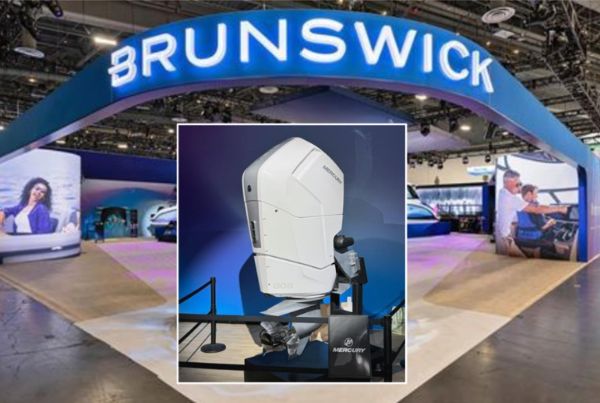
Mercury Marine has never been shy about pushing horsepower boundaries, but its newly displayed 808-horsepower, 7.6-liter V12 outboard concept may be the clearest signal yet that the company sees ultra-large outboards as a permanent alternative to traditional diesel inboards on big boats. The engine, shown publicly as a concept at the recent Miami International Boat Show but not yet offered for sale, is based on the same architecture as Mercury’s existing 600-hp V12 Verado and is aimed squarely at the super-sport yacht and large center-console markets.
While Mercury has released no formal specifications, pricing, or production timeline, the concept alone has generated excitement among builders and buyers who once assumed that boats over 40 or 45 feet simply had to rely on inboard diesels for adequate power, durability, and range.
That assumption was already blown away by the success of Mercury’s 600-hp V12 Verado. Since its introduction, the 7.6-liter naturally aspirated outboard has found homes on an increasing number of large offshore center consoles, luxury cruisers, performance-oriented yachts and even on high-end pontoon boats. Builders who once would not consider outboards at this scale are now designing hulls specifically around them, and buyers have proven willing to pay whatever it takes to own them.
What would the 800 cost? From a pricing standpoint, the 600-hp V12 provides a useful benchmark. Currently a new 600-hp Verado in the low-to-mid-$80,000 range per engine, depending on shaft length and configuration, before rigging and installation. That makes speculation about an 808-hp version fairly straightforward. If Mercury were to bring the concept to market, a retail price north of $100,000 per engine would not be surprising, particularly if additional internal strengthening, higher-output tuning, or forced induction were involved.
That sounds steep—until it’s compared to a traditional diesel inboard system producing similar power.
An 800-hp marine diesel inboard, from manufacturers such as Volvo Penta or comparable U.S. suppliers, typically costs $80,000 to $90,000 for the engine alone. But that figure is only the starting point. A diesel installation also requires a heavy-duty transmission or gearbox, shafting, struts, cutlass bearings, propellers, exhaust systems, cooling infrastructure, electronic controls, and extensive installation labor. By the time a complete inboard diesel drive system is installed and commissioned, total costs commonly reach $150,000 to $200,000 or more per engine, depending on the boat and yard rates.
By contrast, a large outboard is a self-contained propulsion unit. The engine, gearbox, cooling system, exhaust, and controls are integrated into a single package that bolts to the transom. Installation is faster, less invasive, and generally less expensive. Replacement is simpler as well: when an outboard reaches the end of its service life, it can be removed and swapped without tearing into the boat’s interior or engine room.
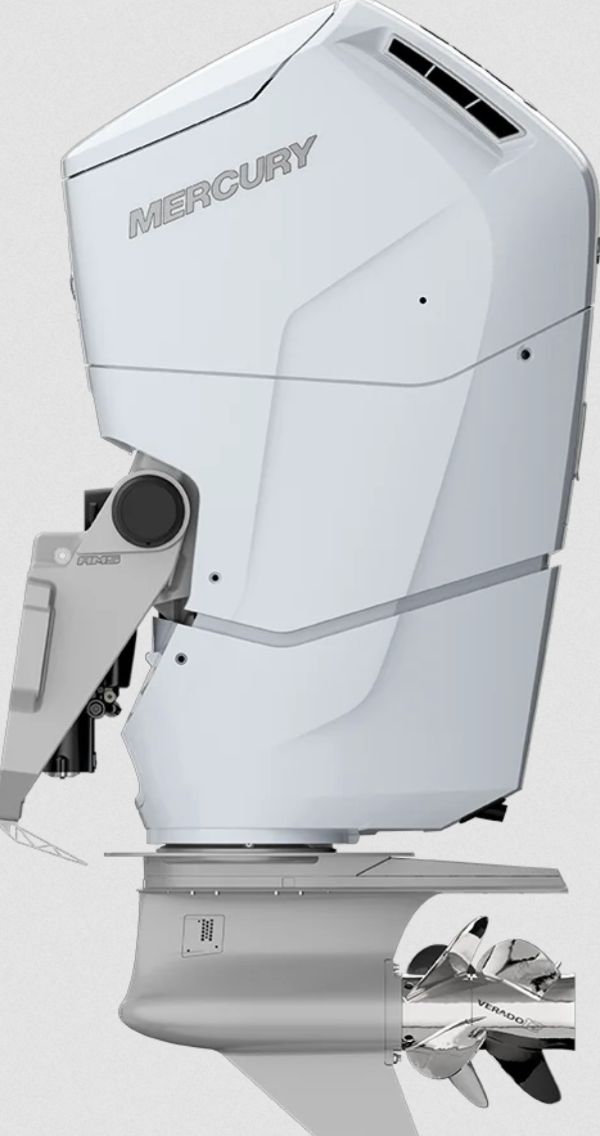
Those practical differences are a major reason large outboards have gained traction. They are typically quieter at cruise, with less vibration transmitted into the hull. Service access is easier, often performed with the boat in the water. Redundancy is built in on multi-engine boats, providing peace of mind offshore. And by eliminating large engine rooms, designers gain much more usable interior space or storage.
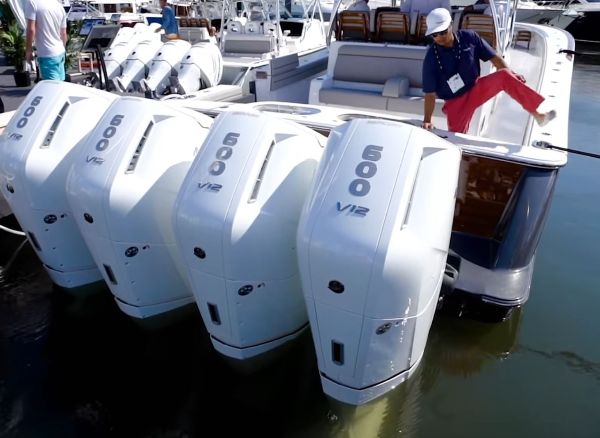
The 600-hp V12 has already helped shift perceptions. In testing and real-world use, dual 600s have shown the ability to replace triple-engine setups with lower-horsepower outboards while improving cruise efficiency and simplifying rigging. Owners report smooth power delivery and noise levels that rival—or undercut—many inboard installations.
An 808-hp version would push that trend further. For large center consoles in the 45- to 55-foot range, it could mean running fewer engines while still achieving high cruise speeds and strong acceleration. For performance-oriented yachts, it offers a way to avoid the weight, noise, and complexity of diesel machinery without sacrificing horsepower.
Outboards also provide easier control at docking, especially when linked to a joystick, which virtually all high end systems now are. The articulating lower unit of the 600 and the experimental 808 rotates independently from the midsection and powerhead, giving a much wider range of motion.
None of this means diesel inboards are going away. For long-range displacement cruising and commercial applications, diesel remains unmatched. But Mercury’s 808-hp concept underscores how far outboards have moved up the food chain. What was once considered the only viable option for big boats is now simply one of several.
If Mercury does bring the 808-hp V12 to market—and it will be surprising only if they don’t--it won’t just be about setting a new horsepower number. It will further cement the idea that outboards—once reserved for smaller boats—are now credible, and often preferable, propulsion systems for vessels that used to live exclusively in diesel territory.
– Frank Sargeant
Frankmako1@gmail.com