
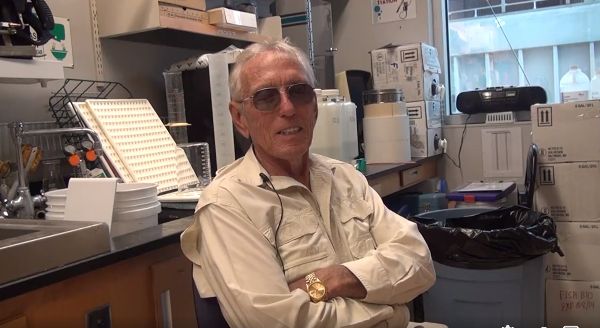
The Florida fisheries and conservation community is mourning the passing of Ronald G. Taylor, a widely respected biologist whose 33-year career with the Florida Fish and Wildlife Conservation Commission and its Fish and Wildlife Research Institute in St. Petersburg helped define modern management of the state’s marine fisheries—most notably the iconic common snook.
Throughout his career, Taylor was recognized as one of the world’s leading authorities on snook biology and management. His work combined rigorous field science with a practical understanding of fisheries, producing research that directly informed regulations, stock assessments, and long-term conservation strategies.
Ron was a friend to recreational anglers throughout his career, authoring multiple studies aimed at improving populations of Florida’s favorite inshore species.
His early work included evaluations of shrimp trawl bycatch—which resulted in pushing shrimpers out of many Florida estuaries where they were killing countless baby gamefish-- assessments of the fish trap fishery in the Florida Keys, and life-history studies of red drum, black drum, spotted seatrout, and other marine favorites of sport fishing. Over time, his focus increasingly centered on common snook, a species of immense cultural and economic importance to Florida anglers.
For more than 20 years, Ron led Florida’s snook research program, overseeing exploitation studies, angler intercept surveys, telemetry projects, genetic analyses, and extensive fish collections.
He did an extended catch and release study as well, with recreational anglers (including me) providing snook for a large net-pen in Tampa Bay, where the fish were observed for extended periods after being caught on various baits and lures. The conclusion was that most fish, properly handled, survived catch and release.
His overall work provided the population-level data necessary to understand snook growth, mortality, movement, and spawning behavior—information that remains foundational to how the species is managed today.
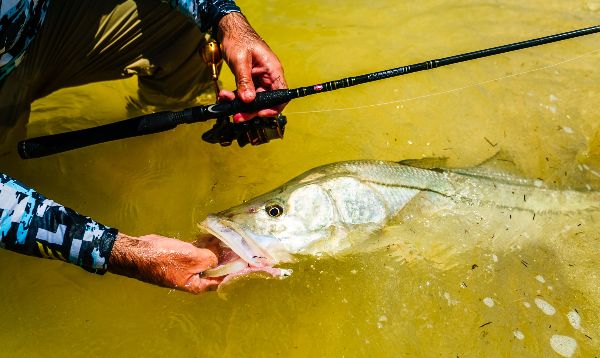
Among his most influential scientific contributions was the discovery, made with collaborators, that common snook are protandric hermaphrodites, maturing first as males before transitioning to females later in life. That finding fundamentally altered scientific understanding of the species and played a central role in the development of modern stock assessment models and harvest regulations.
Ron also contributed to research documenting habitat use and migration patterns of snook, including their reliance on coastal rivers, estuaries, and near-shore reefs, as well as studies exploring spawning behavior, stock structure, and population connectivity between Florida’s Atlantic and Gulf coasts—the fish on each coast are slightly different genetically. His work extended into fisheries-monitoring methods as well, including studies on angler tag-reporting behavior that improved data quality for recreational fisheries management.
Over the course of his career, Ron authored and co-authored numerous peer-reviewed scientific papers and technical reports. His expertise was widely sought, and colleagues frequently described him as the world authority on common snook.
In recognition of his national and international impact, Taylor received the American Fisheries Society’s William E. Ricker Resource Conservation Award in 2014, honoring his long-term contributions to aquatic resource conservation. Earlier, he was nominated for the Rich Cailteux Award in 2010 for outstanding service and achievement in fisheries science.
He was also much admired by his colleagues and supervisors at FWRI.
“Ron’s dedicated commitment to understanding the biology and ecology of Florida’s nearshore sport fish over a stellar career of more than 30 years directly contributed to the sustainable management of these stocks and resultant world class fisheries,” said Gil McRae, director of FWC’s Fish and Wildlife Research Institute. “He was recognized as the foremost expert on common snook and widely admired for his collaborative approach and straightforward communication style that will continue to serve as models of public service science for many years to come.”
Beyond his research, Ron was deeply committed to outreach and mentorship. He spent considerable time working with fishing guides, conservation organizations, outdoor writers, and the angling public, helping translate complex science into clear, practical information. His calm, patient explanations—in a Deep South drawl--earned trust across the fisheries community and helped build broad support for science-based management.
Ron was also a dedicated professional leader, serving as president of the Florida Chapter of the American Fisheries Society in 1992 and remaining an active member and mentor throughout his career. In 2008, he was honored by the Snook Foundation and the Florida Guides Association for his contributions to snook conservation.
Even late in his career, Taylor continued active research, investigating snook habitat use in southeast Florida’s coastal rivers and near-shore reef systems—work that reflected his belief that fisheries management must continually evolve with new information.
Ron Taylor’s legacy is measured not only in scientific papers and regulations, but in healthier fisheries, better-informed management, and generations of anglers who benefit from science done carefully, patiently, and with integrity. Florida’s marine resources are stronger because of his life’s work. He made a difference.
– Frank Sargeant
Frankmako1@gmail.com