
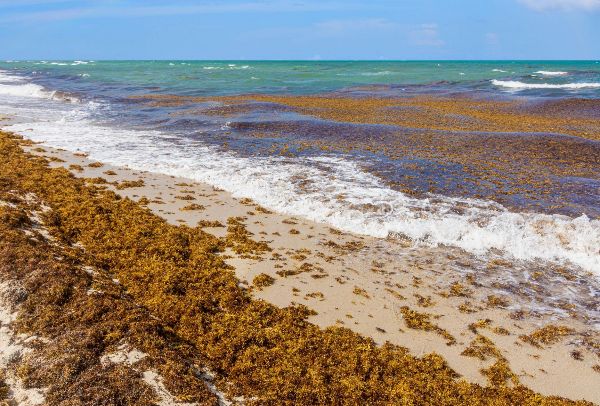
Florida and Alabama beach towns are floundering through another summer of sargassum, the free-floating brown algae that piles up along shorelines, rots in the heat, and turns postcard beaches into something closer to a compost heap. Florida is taking a double dose, with tons of it washing ashore on both Atlantic and Gulf beaches, and researchers say more is coming. What long existed as an offshore curiosity—and, for fishermen, often a welcome sight—is now a recurring coastal headache with no easy fix.
Sargassum, per scientists, is a free-floating golden brown macroalgae, not a rooted seaweed, and its biology is unusual. Unlike most plants, the pelagic forms spend their entire life adrift. Tiny air bladders keep it at the surface, where it gathers into mats that can stretch for miles. Historically, the heart of that system has been the Sargasso Sea, a relatively stable zone in the North Atlantic where currents corral floating sargassum into long-lived rafts supporting a specialized ecosystem.
The stuff is legendary among offshore anglers as a magnet for dolphin-fish, or mahi-mahi, which patrol the weed lines picking off the minnows, crabs, and other critters that begin life in the floating algae. Where dolphin gather, marlin, wahoo, and other blue-water gamefish aren’t far behind. It was—and still is—a critical part of the offshore ecosystem, while also creating great fishing. Closer to shore, a mat of floating sargassum is likely to hold fat tripletails and sometimes juvenile sea turtles as well.
For centuries, that offshore balance largely held. Some sargassum broke free and wandered, but it rarely arrived on beaches in the volumes seen today.
Over the past decade, scientists have documented the emergence of what they call the Great Atlantic Sargassum Belt, a seasonally forming band of algae stretching thousands of miles from West Africa across the Atlantic, through the Caribbean, and into the Gulf of Mexico. That belt did not exist—at least not at this scale—in the historical record.
Scientists point to several forces driving the expansion. Nutrients are high on the list. Increased runoff from major river systems, including the Amazon and Mississippi, delivers nitrogen and phosphorus that act like fertilizer. Warmer ocean temperatures lengthen the growing season and speed reproduction. Shifting winds and currents then move the algae into corridors that funnel it toward the Caribbean and Gulf. Taken together, those forces have created a problem that costs beach communities hundreds of millions—and potentially billions—of dollars from Jacksonville to Gulf Shores.
Researchers at the University of South Florida College of Marine Science have become leaders in tracking that movement. Using satellite imagery paired with transport models, they estimate the size of seasonal blooms and forecast where landfall is most likely. In recent years, those forecasts have included numbers that once seemed unimaginable—tens of millions of tons floating offshore during peak months. This year is already shaping up as one of the worst on record, with thick stacks of sargassum decorating beaches that would normally be crowded with summer visitors.
Once stranded, sargassum begins to decay quickly—and announces itself in the process. The hydrogen sulfide released during breakdown produces a rotten-egg smell that can blanket beachfront communities. Thick wrack lines can trap nesting sea turtles, smother shorebird foraging areas, and alter sand chemistry. For towns built around tourism, the visual and olfactory impact can be immediate and costly, especially now, when a single photo can circle the globe before the tide goes out.
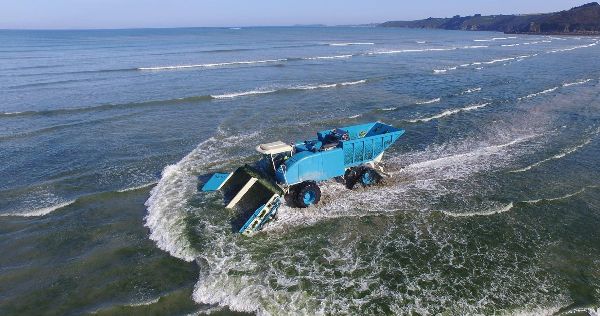
Cleanup is neither cheap nor simple. Heavy equipment removes algae quickly but risks crushing beach life and scouring sand. Manual removal is slower and labor-intensive. Leaving it in place allows nutrients to recycle into the beach system, but at the cost of weeks of odor and unsightly conditions. People simply won’t visit a beach where both the sand and the surf are loaded with rotting weed.
For fishermen, the flotsam has become a paradox. Offshore, it still attracts fish, but when there’s too much of it, trolling becomes an exercise in clearing lines rather than catching fish. The sheer abundance of habitat also spreads fish out, eliminating the clean, fish-stacking weed lines anglers rely on. In the surf, keeping a bait in the water can become nearly impossible as lines foul with algae within minutes.
And for beach towns that depend on the multi-billion-dollar business of renting rooms and filling waterfront restaurants, repeated sargassum invasions can feel like a slow-motion disaster, approaching hurricane-level economic damage without the insurance payout.
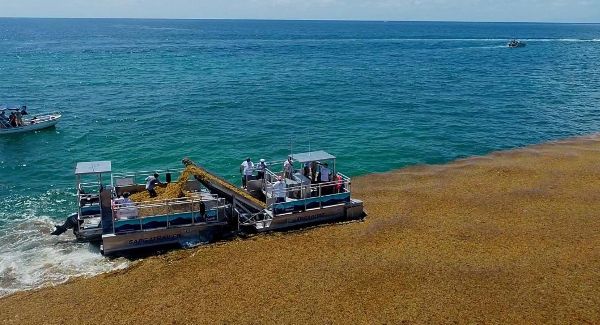
There are a few attempts at short-term remedies, including nets off prime beaches to keep the weeds away and various forms of harvesters, both via boat and heavy beachside machinery. But the harvesters are expensive, and the cleanup may last only a day or two before tons more sargassum comes ashore. Some attempts are underway to turn the stuff into animal food, but there’s so much of it and the market is thus far so limited that this seems an unlikely cure.
Bottom line is that sargassum is here to stay, and it could become a slow motion train wreck for beach towns that depend on pristine sand to attract visitors during the prime summer season.
– Frank Sargeant
Frankmako1@gmail.com