
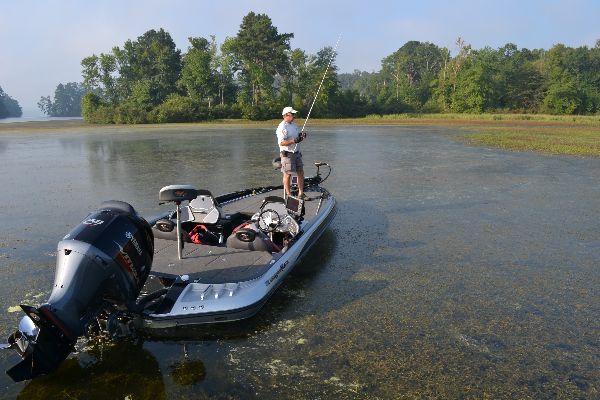
This is the season when aquatic plants peak—welcome cover for bass anglers, a nuisance for swimmers, PWC riders, skiers and many lakefront owners. Some reservoirs turn into marshy wastelands as weeds thicken enough to foul props, burn out trolling motors and stop jet drives cold.
Alabama’s famed 69,000-acre Lake Guntersville is the extreme case.
For decades the lake’s vegetation has been both its greatest asset as a bass fishery and one of its biggest headaches for boaters. The same grass that shelters largemouths and panfish and their forage also clogs boat lanes, marinas and shorelines. Guntersville supports more aquatic vegetation than any other major Tennessee River reservoir because its physical layout is an enormous natural greenhouse.
Unlike deeper, steeper-sided TVA lakes, Guntersville flooded a broad river valley, creating thousands of acres of shallow flats, creek arms and gently sloping bottoms. Average depth is only about 15 feet, so sunlight reaches the bottom across vast areas. Peak surveys have recorded 15,000 to more than 20,000 acres of plants. The fertile watershed, long growing season and relatively stable water levels (typically only a couple of feet of seasonal fluctuation) further favor growth.
Those same conditions are very good for the fishery. Moderate vegetation provides nursery habitat, concentrates bait and gives adult bass ambush cover. It also sucks excess nutrient out of the water, increasing clarity, which makes it easier for bass and other gamefish to see and capture prey.
But, when the water gets thick enough to plow, it’s not so welcoming. It’s been a common occurrence on Guntersville. The lake has cycled through dominant species. Eurasian watermilfoil was widespread in the 1980s and 1990s. Hydrilla later formed legendary underwater jungles that helped cement the lake’s reputation for big bass, only to decline under grass carp, herbicides and changing conditions. The slowdown in ‘drilla didn’t end the vegetation problem.
Another plant—a true villain--was already expanding.
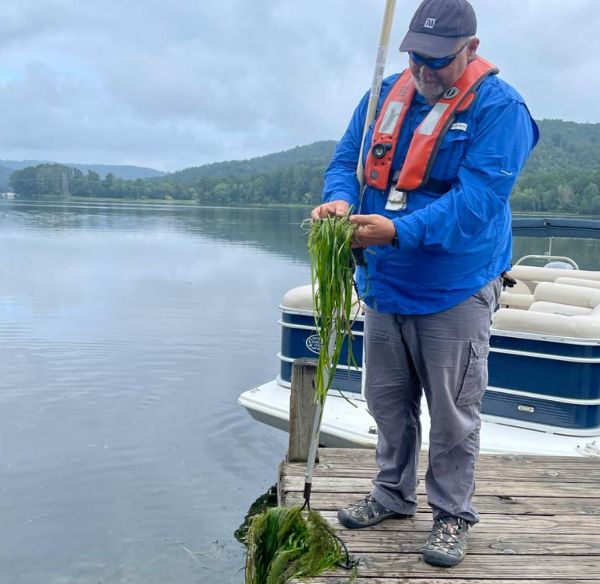
That plant is the hybrid eelgrass known as “Rockstar” (Vallisneria × pseudorosulata), a cross of two Old World Vallisneria species that apparently arose in cultivation. Researchers point to the aquarium and ornamental trade as a likely source. It was established in Florida lakes and rivers before appearing in the Tennessee River system; TVA biologists believe the Guntersville population originated there.
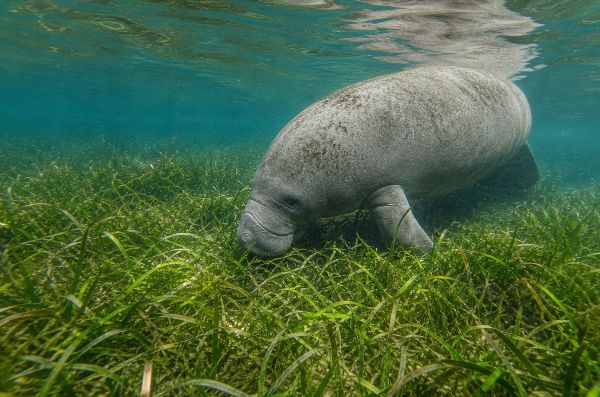
Reportedly it was once widely planted in restoration projects under the mistaken belief it was native Florida eelgrass. In any case, in Florida, the manatee population loves to eat the stuff—they keep it under full control.
Exactly how it reached Alabama remains unknown, but boat traffic is a plausible pathway. Guntersville draws anglers from across the eastern United States, including many from Florida who trailer boats north for tournaments and recreational trips. Alabama fishermen also travel to Florida and return with the same boats. A fragment lodged on a trolling motor, propeller, anchor, trailer bunk or other wet gear can survive a long haul. Only one live piece is needed to start a colony.
Major national tournament circuits reinforce this pathway. They usually schedule their first events of the year in Florida due to the warmer weather, then move northward to waters like Guntersville as spring progresses. This means dozens or hundreds of boats transporting whatever weeds are left in the bilge or on the trailer to launch at the tournament sites.
Some of the earliest Rockstar on Guntersville was around Goose Pond in 2019–20, next to a major launch heavily used during national bass events. The location doesn’t prove a tournament boat introduced the plant, but it’s a logical place for an aquatic hitchhiker to appear.
Once established, Rockstar goes crazy; fragments break free and are carried by wind, current and further boat traffic to start new colonies. It has since moved into neighboring reservoirs—Wheeler, Wilson, Pickwick and Nickajack—making it a system-wide issue for TVA.
Guntersville’s shallow, fertile, stable conditions favor the hybrid far more than most Florida waters. Rockstar is also cold-tolerant; ordinary Alabama winters don’t eliminate it. TVA has found that winter drawdowns help only when plants are fully exposed to freezing air and drying. Guntersville’s modest drawdown rarely achieves that lake-wide, so managers pursue control rather than eradication.
Mechanical harvesting clears floating mats from boat lanes and high-use areas. Selective herbicides treat public access points and developed shorelines. TVA removed roughly 120,000 cubic yards of eelgrass from Guntersville in 2023, about 90,000 in 2024 and approximately 70,000 in 2025—progress against the worst nuisances, though the plant is not disappearing. (Spraying is a whole issue in itself—lakefront homeowners love it, anglers say it ruins fishing and may actually kill fish, which TVA denies . . . .)
The grass is not a total blessing for anglers, in any case. The broken strands floating everywhere foul most lures, limiting fishing tactics. And in some areas the weeds form a mass so thick that bass can’t even use it as habitat—there’s no open water from bottom to top.
In time Rockstar will hopefully slow down, with coverage fluctuating according to rainfall, clarity and winter weather. Whether native water critters eventually exert some sort of natural control remains an open question.
The broader lesson is how readily a plant that finds ideal conditions can expand with human help. However Rockstar arrived this “weed” is a permanent part of the Tennessee River landscape and is likely to keep hitchhiking to other waters for the foreseeable future.
Clean, drain and dry, guys. And hope Rockstar does not come to a lake near you anytime soon.
– Frank Sargeant, Editor, The Water Wire