
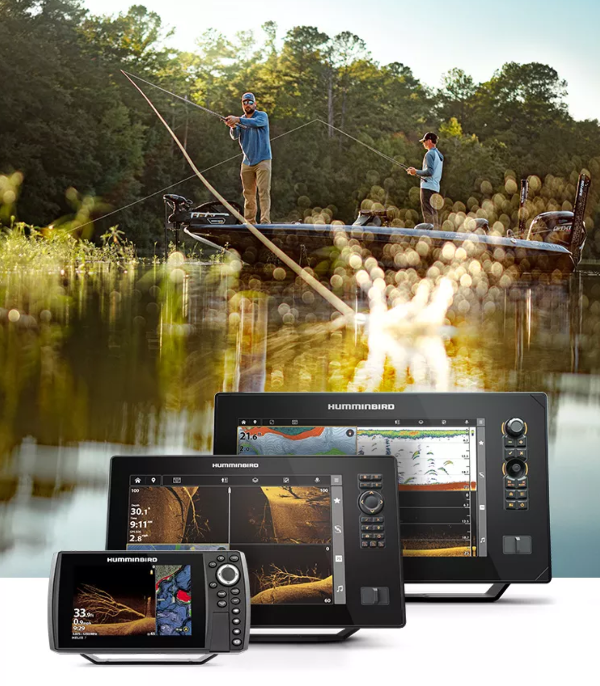
Minn Kota and Humminbird are teasing a major technology announcement for Oct. 6, but they’re playing it very close to the vest at this point. The heads-up release says the tech is entering a “whole new chapter,” but they aren’t saying what’s coming.
Why an announcement before the announcement? The hint is that it’s something evolutionary enough to warrant more attention than the usual incremental advances in this rapidly changing field.
Since they won’t tell us yet, let’s speculate.
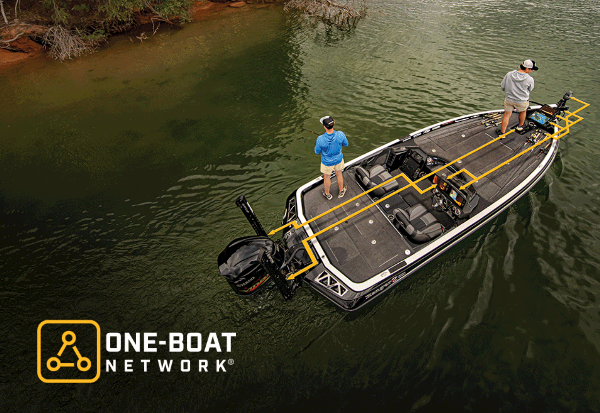
Minn Kota and Humminbird, both Johnson Outdoors brands, have spent years building the One-Boat Network, linking trolling motors, sonar, GPS, mapping and other electronics. That integration already goes well beyond simple communication between devices. An angler can use a Humminbird display to control a compatible Minn Kota trolling motor, navigate to waypoints, engage Spot-Lock and operate compatible shallow-water anchors.
Several recent Johnson Outdoors patent developments provide some intriguing hints on what might be next.
A patent granted Aug. 11 covers a system in which a sonar array mounted on a trolling-motor propulsion unit can be controlled independently of the motor itself. The arrangement uses a second motor to steer the sonar and compensate for movement of the trolling-motor propulsion unit, allowing the sonar to maintain its orientation toward a selected target as the motor changes direction.
That sounds familiar to anglers who have used Humminbird's MEGA Live TargetLock, which already allows the live-sonar transducer to remain aimed at a structure or other target while the boat moves. Johnson Outdoors received another patent in 2025 covering a target-locking system that uses GPS and inertial sensors to keep sonar pointed at a selected target as the boat moves or rotates.
Then there is a particularly interesting Johnson Outdoors patent application involving what the computer industry calls “if this, then that” operation. The concept allows one marine device to recognize a condition and automatically trigger an action in another. The patent family encompasses trolling motors, GPS, sonar and shallow-water anchors.
None of that proves what will be unveiled Oct. 6. Patent applications often cover technology that never makes it into production, and companies routinely patent ideas simply to protect future development.
But the pieces are beginning to look as though they belong to the same puzzle.
Johnson Outdoors also has been working on ways to make multiple sonar systems operate together more effectively. A June 2026 patent application describes a precise-time network that synchronizes the sonar pinging of multiple fish finders on the same boat, using a common clock and scheduled pinging to reduce crosstalk and interference.
Another 2026 application describes a sonar target-enhancement system designed to make fish and lures more visible in live-sonar images without similarly enhancing bottom and structure.
And a patent application published in August describes a curved transducer with individually controlled electrode segments that can vary the distribution of sonar energy within the imaging cone according to user settings, fishing modes or environmental conditions.
Consider what today's electronics already can do. A Humminbird can display detailed mapping and live-sonar imagery. A Minn Kota can hold the boat on a GPS position, follow a contour or navigate to a waypoint. TargetLock can keep sonar trained on a selected target while the boat changes position.
The obvious question is what happens when the electronics begin using all that information to make decisions about boat position and sonar orientation simultaneously. Will the system lock on to a fish Ahab-like and hunt it down?
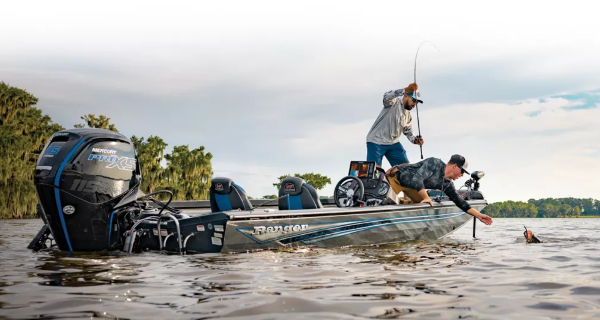
That's still speculation, and there's no reason to assume Minn Kota and Humminbird are about to introduce a self-driving bass boat.
But the industry is clearly moving toward greater automation. Forward-facing sonar has changed how anglers locate and track individual fish. GPS trolling motors have changed how precisely they can position a boat. Live-sonar target locking has connected the two technologies more closely. The logical progression is to have those systems do more than share information—to have them use that information to control what happens next.
Whether any of these technologies appears in the Oct. 6 announcement remains unknown.
For now, Minn Kota and Humminbird are keeping the details hidden. But the patent trail suggests that something more interesting than another incremental electronics upgrade could be coming.
The real question may be whether they are preparing to introduce another new piece of fishing equipment—or a new way for the equipment anglers already have to work together. It will be fun to see what comes next.
– Frank Sargeant, Editor, The Water Wire