
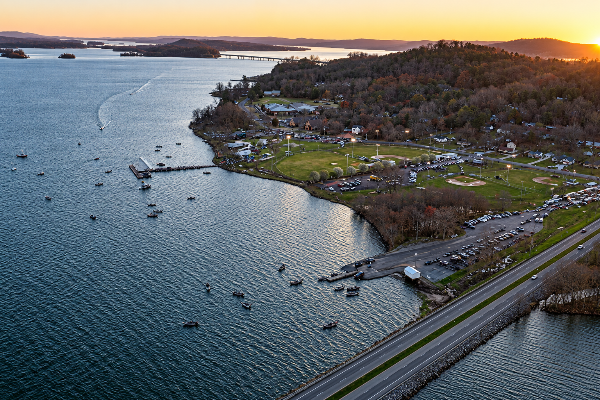
Northeast Alabama’s Lake Guntersville has become one of the great tournament lakes in the country, and there’s good reason. It produces tons of quality largemouths, and at 69,000 acres it’s large enough to spread out a tournament field. Plus it’s located in the heart of the bass tournament homeland.
The tournament business has also become an important part of the local economy, supporting tackle shops, boat dealers, marinas, restaurants, lodging businesses and guides.
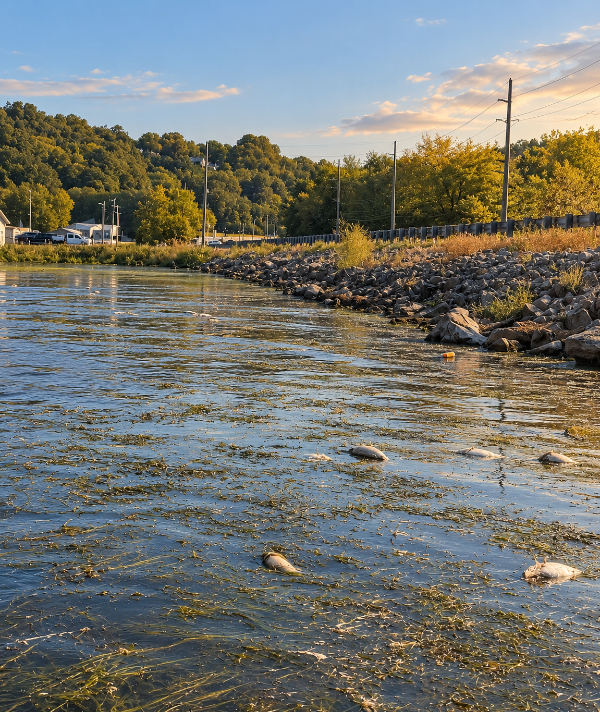
That’s why the unusual number of dead bass found around the Brown’s Creek area after last weekend’s Major League Fishing college and high-school tournaments were so disturbing. A local guide reported counting more than 100 dead fish, and local TV picked up the story, resulting in widespread public angst. The dead fish were right beside the Highway 69 causeway, so a whole lot of people saw the floaters.
MLF subsequently acknowledged that tournament fish were among those that died, called the number unacceptable and said it would review its procedures and take steps to prevent a repeat.
The uncomfortable part is that this can happen even when everybody involved is trying to do the right thing. Bass tournaments helped turn catch-and-release into standard practice among serious anglers, and tournament organizations have spent years improving livewells, oxygen systems, weigh-in procedures and release boats. Most tournament fishermen take good care of their fish because they understand that the future of their sport depends on healthy bass populations.
Research has documented delayed some mortality in tournament-caught largemouth bass for decades. Fish that appear perfectly healthy when released can die later from the accumulated effects of capture, handling, confinement and transport. Studies have also found that mortality increases as water temperatures rise, which makes the problem particularly important on Southern reservoirs during the warmer months.
The traditional tournament routine can put a remarkable amount of stress on a fish. A bass caught early in the morning may spend six or eight hours in a livewell, often with four other fish, while the boat moves from one end of a big reservoir to another. At the end of the day, the boat heads for the weigh-in, the fish are transferred into bags, carried to the scales, weighed and photographed, then hauled back to the release point. A fish caught in deep water may have additional problems associated with the rapid change in pressure as it is brought to the surface.
The fact that the fish swims away at the end doesn't tell us what happens over the next few hours or days. Studies of tournament mortality have found that some of the deaths occur after the fish have been released, which means a tournament director can look at a hundred fish swimming away from the release boat and still have no idea how many will be alive a week later. Some extended studies have shown about 9 to 10 percent mortality—not huge, but not zero, either.
That matters most with the bass tournament anglers are trying hardest to catch. A four-, five- or six-pound largemouth is a fish that has survived years in the lake, found enough food to grow large and avoided predators, disease, drought, floods and thousands of hooks. Those big bass are a significant part of what makes Guntersville valuable as a fishing destination, and they are not easily replaced.
The usual response is that Alabama law allows an angler to keep bass within the legal daily limit. That's true, but it misses the point. Very few serious bass anglers go to Guntersville to put five big largemouths on a cleaning table. The modern bass-fishing culture has deliberately moved toward releasing the biggest fish, and tournament fishing has been a major part of that change.
If we are going to call the practice catch and release, the objective ought to be keeping the fish alive after the release.
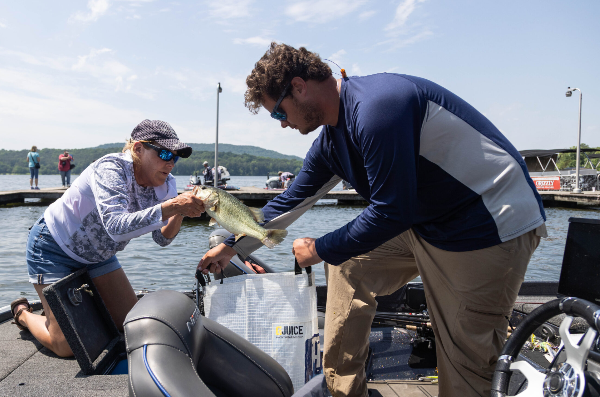
Major League Fishing’s premiere competition level has already demonstrated a practical alternative. Its catch-weigh-release system weighs the fish in the boat and returns it immediately, eliminating hours of livewell confinement, the run to the weigh-in and the handling involved in getting the fish across a central stage. BUBBA's electronic scales and SCORETRACKER LIVE allow weights to be transmitted from individual boats to the tournament leaderboard, making the system practical on a scale that wasn't possible a generation ago.
But there’s an obvious problem with that system: somebody has to make sure the reported fish and weight are legitimate. MLF solves that in its professional events by putting an official in each boat. That’s impossible in smaller tournaments, but there are other possibilities, including cameras, electronic records and independent verification. It is a problem that can be solved with tournament rules and technology.
Fish mortality is harder to solve after the fish has been hauled across the lake and released.
Stocking Won’t Solve the Problem
Another proposal that has surfaced in the Guntersville discussion is charging large tournaments a fee and using the money to restock the reservoir. That sounds reasonable until you look at what stocking actually accomplishes in a large reservoir that already has a healthy bass population.
Alabama fisheries biologists have repeatedly pointed out that stocking largemouth bass into waters with adequate natural reproduction generally does not produce more bass for anglers. A reservoir has a finite supply of food and suitable habitat, and young bass already produced naturally are competing for those resources. Most of the hundreds of thousands of young bass produced every year die before reaching catchable size. Adding hatchery fingerlings doesn't create more food or habitat for them. And hatchery fish are dumb, easy food for crappies, gar and other bass. Studies have shown that almost none survive to adulthood.
That leaves tournament organizers with some choices that are considerably more useful than writing a check for replacement fish. Traditional weigh-ins could be limited when water temperatures reach levels known to increase mortality. Large tournaments could be required to use better oxygenation and fish-care equipment. Tournament fields could be reduced when the number of boats becomes excessive, or large events could use several weigh-in locations so fish aren't transported long distances. Most simply, tournaments could move to immediate catch-weigh-release whenever conditions make conventional livewell-and-weigh-in procedures especially risky.
None of that requires eliminating tournaments from Guntersville. Nobody who understands the local economy wants to do that, and nobody who enjoys competitive bass fishing wants to see the sport disappear. Tournament fishing brings a tremendous amount of money into the region, and the people who fish these events are among the lake's most visible advocates.
What it does require is recognizing that the tournament model that worked when fields were smaller, boats were slower and electronics were primitive may not be the best model for a modern fishery. Today a tournament can put hundreds of boats on the water, all equipped with technology that makes finding and catching bass much more efficient. And thousands of YouTube videos have made all of us better at catching fish. The pressure on the fishery has changed, and fish-handling practices need to change with it.
Hopefully the Guntersville fish kill will be taken as a warning rather than an excuse to attack tournament fishing. MLF has acknowledged the problem and says it will make changes, and that’s hopefully where the discussion ought to go. The tournament industry has already demonstrated that it can change the way bass are caught, scored and released; there is no reason it can't continue improving the way those fish are handled.
– Frank Sargeant, Editor, The Water Wire