
You sort of have to wonder if Ernest Hemingway could win a “Write Like Hemingway” writing contest today in the age of A.I.
One of the bastions of literary writing about fishing, the Traver Award, has just announced it was duped this year by a Romanian participant who submitted a story that was largely penned by artificial intelligence.
While just about everybody is using some form of A.I. today in their daily lives—even if they don’t even know it—using it in a word-smithing contest is definitely foul play. The winner was disqualified, and the runner up was named this year’s winner.
The guy who used A.I. was able to fool a panel of judges made up of past winners of the award as well as several English professors.
(Full disclosure, as a past winner I was one of the judges, but the bogus story was not among those that I judged, so there .)
Here’s what David Van Wie, a lecturer at Dartmouth and avid fly angler who volunteers a whole lot of his time each year to manage the contest, wrote to us explaining the deception:
“I wish I could put a more positive spin on this news, but sadly we have learned a difficult lesson in how AI demons can haunt an honest and earnest writing contest like ours.
“The best news that we have a new winner: Steve Duda and his story “The Goddess of Compassion, Holding Open the Door” has been chosen our new and rightful 2026 winner. This decision came after we discovered (ourselves) that our previous winner was- in the judgement of Pangram, Claude Opus 5.5, Gemini Argon 4.0 and various humans, including a native Romanian speaker- likely 100% AI-generated.
“Because no AI detection can be 100% certain, we followed a judicious protocol of asking the entrant to provide further background information on the story and evidence of earlier drafts or other materials to corroborate the story as human-generated. Incredibly, the response was AI-generated and the material provided was AI-fabricated. We decided to disqualify the entry and choose a new winner.
“This experience has shown us first-hand that we now live in a Brave New World of international scammers who crawl the web looking for paid awards and contests, and submit what are called “prompt-entries” that may contain true personal stories or clever plot outlines with lots of intriguing details and cultural references, but the writing is done by AI, or heavily assisted by AI, as in “read my story outline/draft and the details provided, and write me a story in a style similar to Cormac McCarthy and Ernest Hemingway that addresses the criteria of the Robert Traver award…. Etc.”
“The winning story, now DQ’d story got high praise by our Traver judges in all three levels of judging. A few of us who spotted some story glitches or technical inaccuracies generally forgave them because the overall story was so compelling and different. That is exactly what our perpetrator intended.
The AI detectors spotted a number of other classic AI errors, hallucinations or “botshit” that we might have spotted had we more experience, or were we not mesmerized by the “stunning” writing (thanks to likely copyright infringement in AI training). This isn’t easy. And, truthfully, it was a very good story… just not written entirely by a human doing the hard work of wordsmithing and editing.
“So – we will learn from this.
“We will re-evaluate our AI policy for 2027. . . . hopefully we can keep pace in the AI arms race of cheaters and detectors.”

The whole thing gives a sinking feeling for writers and editors that creative writing as a profession is over. I’d guess outdoor writing is headed for the same cliff. Maybe journalism in general.
Talking heads on TV news? A.I. can do it almost perfectly now, and in a year or two they will be better than humans.
Likely the same for movies. A Tom Cruise that never ages. A Sydney Sweeney whose figure never changes. An Arnold Swarzenegger whose muscles never sag.
Anyway, you can see the new winner of the Traver Award—actually written by an actual human and very nicely done--here: https://amff.org/the-goddess-of-compassion-holding-open-the-door/
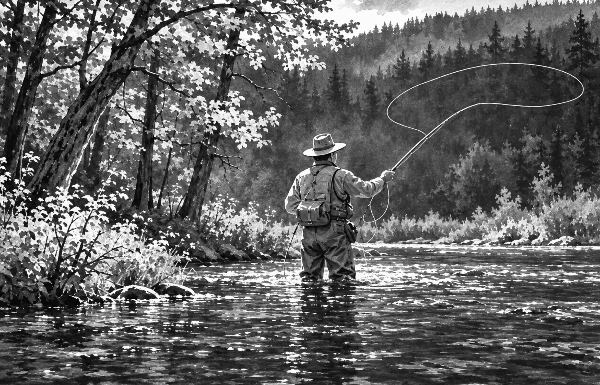
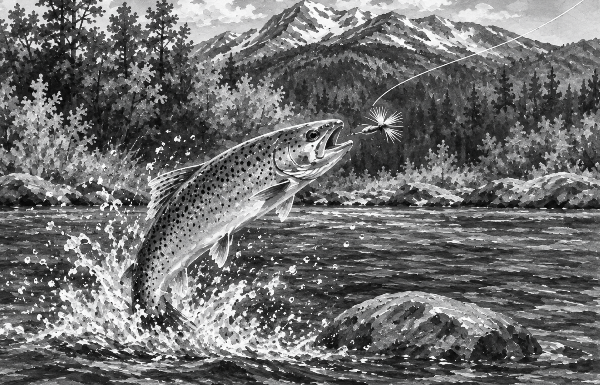
(One more note—ALL of the artwork that you see with this story? It came from ChatGPT, of course.)
– Frank Sargeant, Editor, The Water Wire