
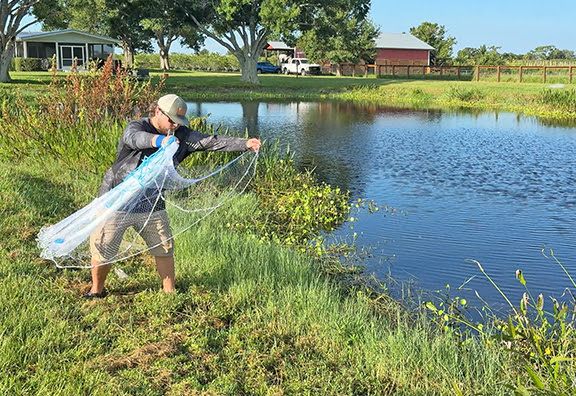
Cast nets are a very popular way to catch bait in Florida.
Nets provide a great way to collect bait like the golden shiner featured above. With a small investment and some knowledge you can catch your own bait — which can provide its own fun!
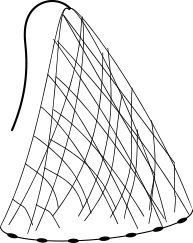
Cast net - A cast net is probably the most widely used net in Florida. It has the advantages of a long reach and wide coverage. However, a cast net is also the hardest net to learn to use, although some bait and tackle shops will provide demonstrations and there are also plenty of videos and books that cover the subject.
Cast nets are ideal for taking shiners and shad. Shiners (featured above) can be baited to a particular area with bread, uncooked oatmeal, or chicken laying mash (check your local feed store for the latter). A good place to start up a "shiner hole" needs to have some open water with vegetation close by. If you're willing to put in some extra effort and cash, you can chum shiners to a particular area at least weekly (twice a week or more is better) and have a semi-guaranteed supply of bait whenever you want it. In such a situation, you can chum your "shiner hole" and start tossing your cast net within five or ten minutes to collect your bait. If chumming "cold" (you haven't been baiting the area previously), you may need to chum for fifteen to twenty minutes before throwing your net. In either case, make your first cast count because the sound of the net hitting the water will scare the baitfish and, while you can still catch them, your chances diminish with subsequent throws. For keeping your shiners alive, an aerated livewell or cooler is best. However, anglers can also make do with a plastic five-gallon bucket with half-inch holes drilled in it for circulation; throw on a bait lid available at any tackle shop and keep the bucket in the water on a rope until you need your next bait.

Shad (see below) are a different story — their occurrence in most waters is much less predictable. They are schooling fish constantly on the move, and are usually found in open water instead of orienting reliably to vegetation. This also means that they're often found farther from shore than shiners are, sometimes putting them out of reach unless you're throwing your net from a boat. Your best bet for a steady supply of shad is to keep a sharp eye out for the distinctive ripple of schools on the surface, or for bass crashing shad on the surface. Shad are also much more delicate than shiners — you'll need a well-aerated baitwell to keep them alive, the bigger the better. Shad schools are usually denser than shiner schools, though, and one lucky cast is all you need to fill a baitwell.
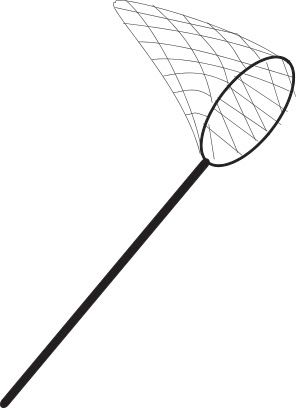
Dip net - Dip nets are simpler in every respect, as well as cheaper. You'll seldom catch a shiner or shad in one, but if you want some grass shrimp or minnows for bream fishing this is all you'll need. If you're using a dip net you'll be restricted to shore, but then that's where you'll want to be using this net anyway. Try scooping the net through shoreline vegetation, and pass the net through the same path several times. Good vegetation to "beat" includes any grass, shallow hydrilla, or peppergrass. After "sweeping" a couple of spots, stop and pick through the vegetation in the net for bait. (Note that most emergent vegetation worked this way will spring back up in a few hours, but be careful not to damage any desirable plant species.) Grass shrimp usually announce themselves by jumping all over the place inside the net bag, and are a great bait for bream and the occasional bass. Minnows aren't quite as fantastic a bait for bream, but are still good and large bluegill in particular have a preference for mosquitofish. Better dip nets have a sturdy wooden handle about six feet long and a heavy-duty wire net frame with a 1/4" mesh bag. Don't go any bigger on the mesh size, or most of what you want to catch will be able to get through it.
Minnow seine - Minnow seines are not as effective or convenient for shiners as a cast net, and are more cumbersome for shrimp or minnows than a dip net. You also can't work one solo — it takes two for this one. They do have the advantage of being capable of covering a lot of territory, however. And seines make great educational tools, if you want to see (or teach your kids about) the variety of life in your local pond. If you're going to use a minnow seine, do yourself the favor of attaching five- or six-foot broom handles or one-by-twos at the ends. This will make the net much easier to work, and make it much easier to keep the lead line on the bottom. They also make the net easy to roll up for storage — but make sure it's completely dry first. To work the net properly, choose a path that will run the net through promising-looking water a few feet deep and then up onto the bank. A gently-sloping bank without much vegetation or brush on it is best if available. Both team members should grasp the broom handles upright and try to keep the lead line on the bottom as they work. There will be a deep bow in the net as you both walk forward in unison. Move as fast as you can to prevent fish from escaping, and do keep that lead line on the bottom or fish will also escape under the net. Run the seine right up onto the bank to inspect your catch, giving priority to releasing any game fish first.
Staying safe - Obviously, you should exercise the same caution when netting as you would when shoreline fishing or wading, watching for deep spots and for wildlife. See FWC's Living with Alligators page for more information.
"Netiquette" - There are some final etiquette points every net-toting angler should consider that have nothing to do with catching fish. First, don't trespass. Respect the space around other resource users nearby. Also, don't leave a trail of weed piles along the shoreline behind you. Some people, even including other anglers, don't like seeing people with nets, so be polite to anyone that asks you what you're doing. Take a moment to explain how much fun it can be to catch your own bait, and maybe even show them some of the interesting creatures you come across doing it.
The full Florida Freshwater Fishing Regulations rules summary for methods of taking bait is available online.