
An early striped bass spawning season is unfolding on the Roanoke River, driven by low flows and warm spring temperatures across the basin. Flows at the USGS gage near Roanoke Rapids are averaging about 3,500 cubic feet per second (cfs), below the historically optimal spawning range of 6,000–8,000 cfs. With limited rainfall so far this year, river flows have remained low.
At the same time, near record highs have pushed water temperatures into the upper 60s this week, squarely within the striped bass spawning window of 64–68°F. Together, low flows and warmer water are accelerating spawning activity. Fishing guides working the upper river have observed active spawning, though a cold front forecast for this weekend is expected to lower water temperatures, likely shifting spawning behavior.
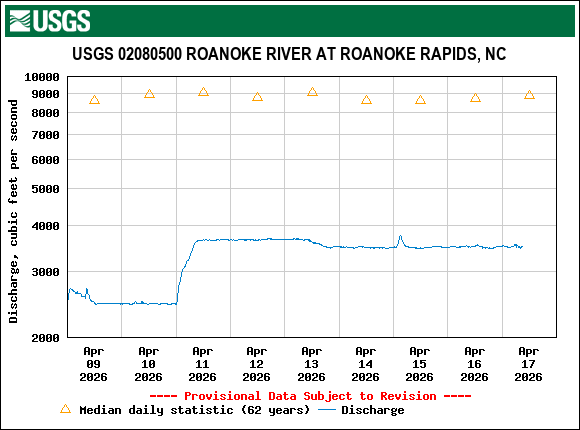
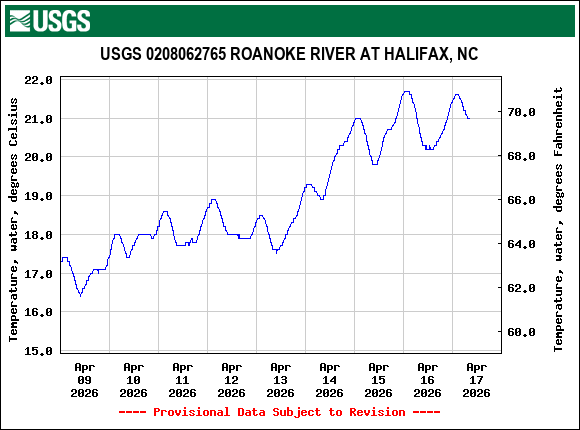
Spawning typically occurs near Weldon, but low flows and warmer temperatures can push activity farther downstream. While not intended as a fishing update, these conditions illustrate how river flow and temperature shape the timing and distribution of spawning in a key coastal fishery. Since 2023, our Foundation has partnered on striped bass recovery in the Roanoke River and Albemarle Sound and is closely tracking what this year's pattern may mean for recruitment.
Every fish carries a kind of flight recorder. Not a black box bolted to a fuselage, but a pair of small, dense structures in the inner ear called otoliths. These calcium carbonate formations help fish hear, sense vibrations, and maintain balance, but they also preserve a detailed record of a fish's life.
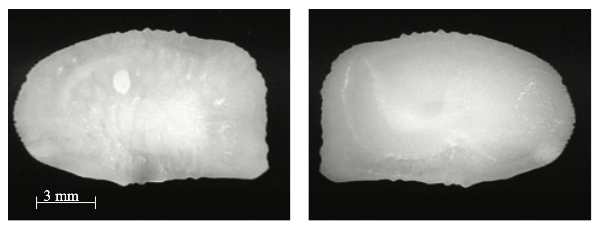
A sagittal otolith of a red drum. Photo courtesy of NOAA
When fisheries scientists slice an otolith and examine it under a microscope, they see a series of bands similar to tree rings. Rapid growth in warmer months creates a wide, opaque band of calcium carbonate, while slower growth in colder months forms a thinner, translucent band. One opaque band plus one translucent band equals one year, known as an annulus. By counting these rings, the timeline of that fish's life begins to take shape. Biologists section each otolith with a diamond-bladed saw, polish the surface to improve visibility, and read the rings under magnification, much like a forester reading a tree stump.
This age data forms the backbone of modern fisheries science. By aging thousands of fish, biologists build a picture of entire populations, including which year classes are present, how fast they grow, and how many survive each year. These insights directly inform management decisions such as size limits, season lengths, and bag limits. Without accurate age data, those decisions lose much of their scientific grounding.
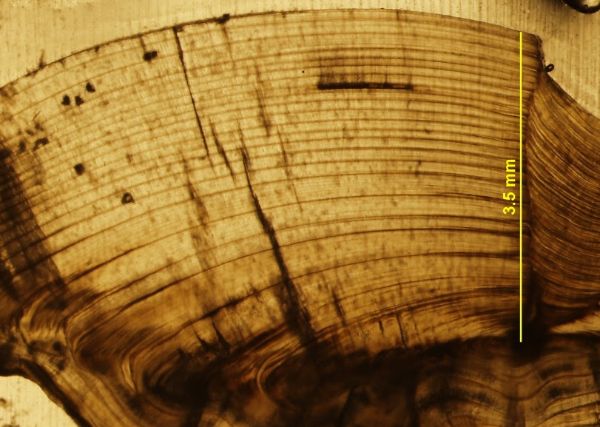
A sectioned red drum otolith. Photo by William Jones via EarthRef.org
Consider North Carolina's red drum fishery. The slot limit of 18 to 27 inches is designed to protect older, mature fish that sustain reproduction while allowing harvest of younger fish. That strategy is grounded in otolith data, which shows how quickly red drum grow and when they reach maturity. One red drum aged in North Carolina reached 62 years old, a powerful reminder of how long-lived these fish can be and why protecting the spawning population matters.
Otoliths reveal more than just age. Each layer also captures elements from the surrounding water, creating a chemical record of the environments a fish has experienced. Strontium concentrations tend to rise in saltwater, while barium increases in freshwater. By analyzing these patterns from the core to the outer edge, researchers can reconstruct a fish's life history, including where it was born, how it moved between habitats, and whether it returned to the same waters year after year.
North Carolina plays an important role in advancing this science. Since 2014, the Division of Marine Fisheries' Carcass Collection Program has received more than 4,100 donated fish, representing 28 species. Each donation contributes valuable age and growth data to ongoing stock assessments. Meanwhile, NOAA's Beaufort Laboratory maintains otolith archives dating back to the mid-1970s, providing decades of historical insight.
The next time you fillet a red drum or flounder, remember that those small, hard stones near the skull are more than anatomy. They are a biological archive, preserving years, sometimes decades, of information recorded in calcium, one layer at a time. For the scientists who study them, otoliths remain one of the most powerful tools in fisheries management, turning a simple ear bone into the knowledge that guides every effort to sustain our coastal fisheries.