
 |
When Capt. Mike Frenette looks at the things he values most in a sport fish — exciting bites, exhilarating battles, and the reward of prized table fare — it’s easy to see why wahoo tops his favorites list.
“The strike, by far, is the attraction,” said Frenette, who runs Redfish Lodge in Venice, La. “You don’t want to fish them on heavy tackle like tuna and marlin; you want to use more medium tackle like kingfish gear so you can enjoy the fight.”
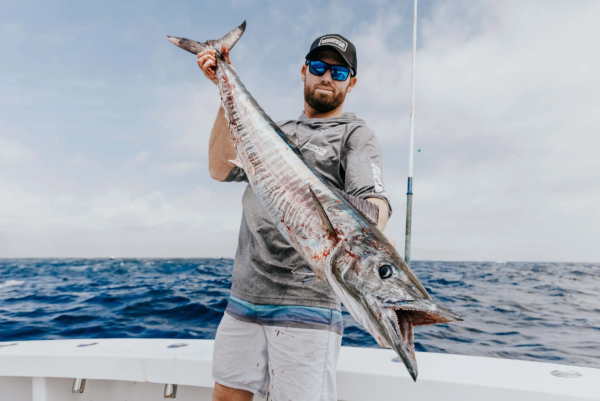
A member of the family that includes king mackerel, wahoo follow the same general shape, but with a couple of distinct differences. First, the wahoo sports distinctive white “tiger” stripes on its flanks. Also, you’ll notice the head comes to a much more narrow point — a detail that facilitates the wahoo’s signature performance trait.
“They're screamers; they’re missiles,” Frenette said of the wahoo’s impressive sprinting ability. When you hook up, there is no question what you have.”
When & Where
Wahoo swim the Gulf of America year-round, but Frenette finds concentrations of hefty fish — 50-plus pounds — from November through February. Likely following food sources, lots of big fish run close to the Mississippi River Delta.
“Compared to a lot of other areas, we have a lot of large wahoo, but it’s not always consistent. You can go one day and whack ‘em and then go two or three days where you pull your hair out trying to find them.”
Frenette has found that wahoo like rock piles and the vertical structure of the Northern Gulf’s oil and natural gas rigs. The fish can be as shallow as 90 feet or as deep as 600. There’s rarely a specific depth zone, but he tends to catch most of his better fish in 300-500 feet.
“Some of the coral/rock areas have some very good consistency. I think the bottom structure holds them longer, whereas the fish that are on the rigs could be 20-25 miles away from one day to the next.”
With fall-winter bringing wahoo potential to both sides of the Delta, Frenette chooses his course based on the wind. This time of year often brings rough seas, but taking advantage of geography can make a big difference.
“We have an advantage in Venice. On some coasts, you can’t run out if you have a certain wind, but we have multiple options. I might run out South Pass, Southwest Pass, or Main Pass, depending on which way the wind is blowing. You definitely want to play the wind. If it’s calm, toss a coin.”
How To Catch ‘Em
Frenette knows the speedy wahoo like to chase down meals, so he’ll start looking for schools of bait and predators while trolling Rapala CD 18 diving plugs. To maximize the lures’ ability to snare the fast-striking wahoo, Frenette retrofits them with Size 4 Mustad 4X Mustad Kingfish Trebles.
“Once I find them with the artificials, throwing out a couple of live baits is an exciting way because they will sky on them,” Frenette said. “It’s a slower-paced presentation, but it can be very rewarding. For lures or live bait, I use a 7-strand non-coated wire leader. I usually use 90- to 135-pound. You can go as light as 60, but I have experienced bite-offs with 60.”
Preferring blue runners, bluefish, large menhaden (“pogies”) or mullet, Frenette rigs his livies with an 8/0 Mustad Demon Perfect Circle Hook in the nose and a stinger segment that positions a No. 4 treble hook behind the dorsal.
Kingfish Treble Hook - 4X Strong
Demon Perfect® Inline Circle Hook - 3X Strong
“I’m a strong believer in Cannon downriggers, as I can deploy my baits to the proper depth that I’m either marking the wahoo or bait clouds. From day to day, that could be 30-100 feet below the surface, and I want to position my baits above the fish because I believe they’re usually looking up. It could be a little more work, but well worth it.”
Another option: Vertical jigging with a Mustad Rip Roller Jig. Once you establish a wahoo bite with live baits, fire down a jig, work it erratically, and hang on!