
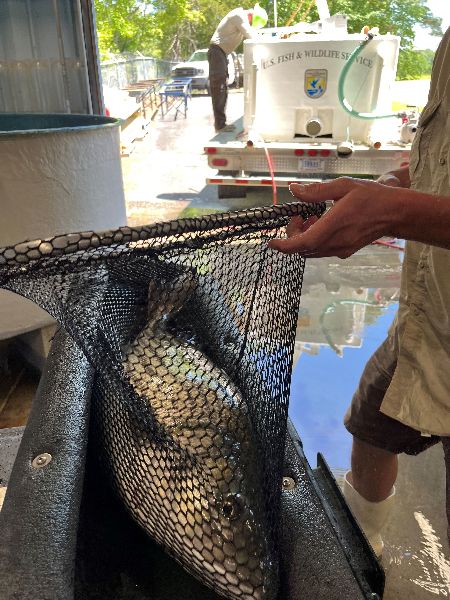
Management of coastal striped bass populations in North Carolina is a collaborative effort between the North Carolina Division of Marine Fisheries and the North Carolina Wildlife Resources Commission. When management strategies call for supplemental stocking, the Edenton National Fish Hatchery, operated by the U.S. Fish and Wildlife Service, plays a crucial role in supporting production efforts.
Each fall, the agencies develop a production plan for the upcoming year. Stocking remains a crucial tool for supporting or rebuilding striped bass populations across coastal river systems. While each river faces its own challenges related to recruitment and survival, these fisheries collectively provide significant economic and recreational benefits to communities throughout eastern North Carolina.
Where Stocking Will Occur
Neuse River
After a two-year pause, stocking will resume in the Neuse River in 2026. Approximately 100,000 sub-adult striped bass will be released during November and December. For the first time, this stocking will use a genetic strain derived from broodfish collected in the Santee-Cooper River system in South Carolina.
Fry will be produced at the Orangeburg National Fish Hatchery and transported in late April or early May to the Edenton National Fish Hatchery in Chowan County. Striped bass will be reared throughout the summer and fall until they reach 5–8 inches.
Tar River
Stocking in the Tar River will also resume in 2026 following a two-year hiatus. A total of 500,000 striped bass fingerlings, measuring 1–2 inches, will be stocked in June. These fish will be produced at the Watha State Fish Hatchery in Pender County.
After more than a decade of using broodfish sourced from the Tar River, the 2026 stocking will use broodfish collected from the Roanoke River spawning grounds, reflecting adaptive management strategies based on ongoing research.
Where Stocking Will Pause
Roanoke River and Albemarle Sound
Following a major three-year stocking initiative, stocking in the Roanoke River and Albemarle Sound will pause in 2026. This will allow fisheries biologists to evaluate the effectiveness of previous stocking approaches. Using genetic marking techniques, scientists will assess the survival, growth, and contribution of fry, fingerlings, and sub-adult striped bass stocking annually since 2023.
Cape Fear River
No striped bass stocking is planned for the Cape Fear River in 2026. However, biologists will monitor the performance of 250,000 striped bass produced from Santee-Cooper broodfish and stocked below Lock and Dam #1 in 2024.
Supporting Restoration Efforts
The North Carolina Marine & Estuary Foundation is pleased to be able to provide financial assistance for the 2026 striped bass production programs and associated genetic monitoring efforts. Our support helps ensure that stocking programs remain science-based and contribute to sustainable and economically viable striped bass fisheries across eastern North Carolina. We look forward to providing updates as our 2026 partnerships are finalized.