
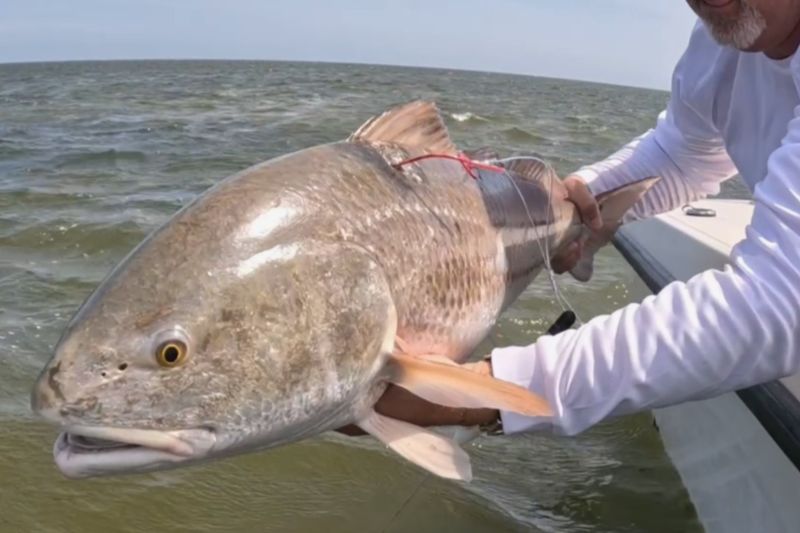
Our first red drum satellite-tagging trip of the year was hosted by Captain Bryan DeHart out of Manteo on a beautiful mid-June morning. Captain Bryan enlisted two accomplished anglers to do the fishing: his daughter, Joy, and her close friend and 10th-grade classmate, Bella Huntingford.
The four of us set sail early with high expectations. The seas were choppy and the wind was tight, but the red drum didn't seem to mind. It didn't take long for Joy to hook a perfect candidate for our first satellite tag of the season.
Like a seasoned pro, Joy brought the 37-inch fish to the boat, and the team sprang into action. Captain Bryan placed the drum in a padded trough, where it was quickly measured. A hose was then inserted into the fish's mouth and positioned to deliver a continuous stream of water over the gills.
To begin the tagging process, a $100 red reward tag was anchored on the left side of the fish just below the dorsal (top) fin. Next, a thin hollow tube was inserted about two inches below the dorsal fin, and a monofilament line was fed through the tube. Plastic discs were threaded onto the line on both sides of the fish and crimped in place to prevent the line from pulling against the skin.
Once the monofilament was formed into a loop, the satellite tag was crimped onto it through a hole at the base of the tag. The tether was adjusted so the tag would "ride" just above and slightly behind the dorsal fin. When the procedure was completed, the fish was returned to the water and promptly released.
After Joy's fish was successfully tagged and released, there was plenty of celebration and excitement on the boat. Nothing like putting the first fish on the board!
Bella soon joined the action, landing a magnificent 47-inch drum of her own, and the satellite-tagging procedure was repeated. On our tracking platform, Bella's fish goes by "Dwight," named after country singer Dwight Yoakam, whose music was playing through the boat's speaker just before the hookup.
The captain and crew landed several more drum in the lower 30-inch range that day, none quite large enough for a satellite tag, but each receiving a yellow reward tag before release. Our trip ended beneath a purple- and orange-hued sunset as we headed back to the access area, a perfect ending to a perfect day.
But as it turned out, that first red drum wouldn't hold onto its satellite tag for long.
Less than two weeks later, Shawn Ganslein, an angler visiting from Ohio, caught a satellite-tagged red drum while fishing with Captain Chris McDonald of First Light Charters.
However, something was odd, to say the least. There was no red reward tag on the fish, and the satellite tag wasn't attached in the usual way. Instead, the fish was "wearing" the satellite tag like a choker around its head.
Captain Chris remarked that at first glance, they thought the fish was tangled in a popping cork. Upon closer inspection, the number on the satellite tag matched Joy's fish. Apparently, this thieving drum had swum through the monofilament loop on the first fish, pulled the tag free, and made it its own. After a few phone calls, the satellite tag and loop were removed from red drum #2, and the tag eventually made its way back to our team.
Quite an improbable sequence of events.
Fast forward two months to a late-August fishing spot on Pamlico Sound. Carolina All Out host and producer Chris Douglas lands a 45-inch red drum under the watchful eye of Captain Scooter Lilley. Armed and blinking green, satellite tag #281098 began a new journey on its third fish, affectionately named "Wilbur" on our tracking platform.
It will be nine months before this well-traveled tag is scheduled to release from Wilbur, float to the surface, and share insights into his movements and habits. In the meantime, perhaps Wilbur will swim close enough to the surface during a satellite pass to give us a sneak peek at his location.
The takeaway for our Foundation?
Make smaller loops…