
Satellite tags don't just tell us where a fish has been; they tell a story in two very different ways. In our North Carolina red drum study, those two data streams come together to reveal how individual fish move through coastal waters, including a red drum named Billy.
The first stream is real-time, opportunistic data. While a tag is attached to a red drum, it continuously records information such as light levels, water temperature, and the Earth's magnetic field. When a fish swims near the surface and sunlight reaches the tag's solar panel, the tag may transmit a brief data packet to satellites in the Argos network. These transmissions are irregular and unpredictable, but they provide exciting check-ins that confirm a fish is alive and offer rough location updates along the way. Finley and Dwight are fitting examples. Both are currently active on the platform, sharing preliminary positions as they continue their journeys.
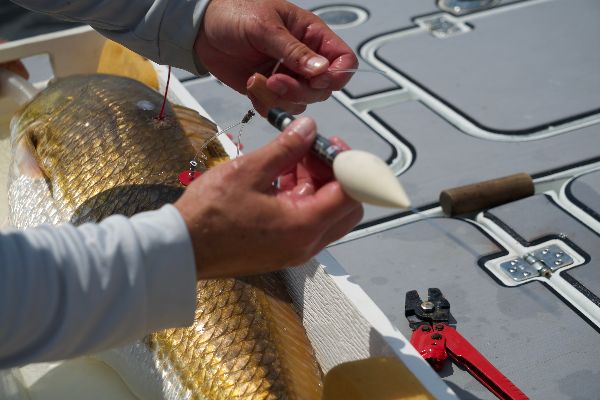
The second data stream arrives at the end of the scheduled deployment. After two months at large, Billy's tag released, floated to the surface, and transmitted its full archived dataset. This complete travel diary includes daily position estimates, temperature records, and a continuous timeline of movement, allowing our researchers to reconstruct Billy's path in greater detail.
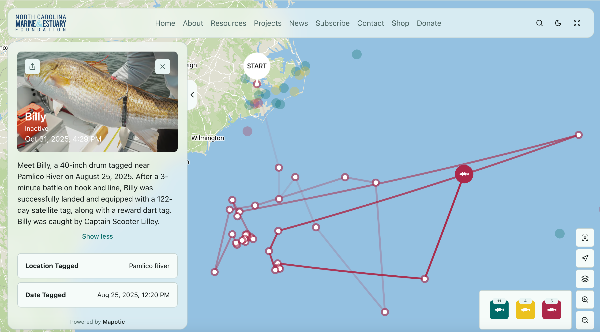
Together, these two streams provide timely insight and completeness. Some fish on the platform, like Finley and Dwight, send postcards during the trip. Others, like Billy, deliver the entire story at once, a two-month journey revealed only after the tag popped free. Most of the satellite tags deployed in the summer of 2025 were programmed to remain at large for either six or twelve months, and we look forward to completing more stories as tags release on schedule.
An added bonus of satellite tagging is the opportunity to recover the tags themselves. After release from the fish, tags continue transmitting for a period of time, allowing researchers to track their drift and potentially retrieve them for reuse or additional data. Although Billy's tag popped off well offshore of coastal North Carolina on Halloween, it continued traveling and transmitting. On Christmas Eve, the tag sent its final message from the North Atlantic, 430 miles off the coast of Newfoundland. If you happen to be up that way, keep an eye out  .
.