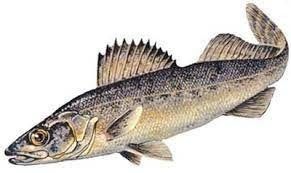
2/1 – Hudson River Watershed: Fish-of-the-Week for Week 352 is the blue pike Stizostedion vitreum glaucum (Hubbs 1926). The blue pike appears on our list of fishes of the Hudson River Watershed as a questionable addendum where it sits just below the walleye. If you would like a copy of our watershed list of 239 fishes, e-mail trlake7@aol.com.
This is not a typical Fish-of-the-Week. Today we go in search of the blue pike. Legends that linger in the memory of the masses often take on a life approaching reality. This Almanac entry is a broad-reaching story of a near mythical fish that transcends time, space, perhaps even its existence, that touches our watershed.
For Ed McGowan, Assistant District Manager, NY State Parks, the stories lasted and resurfaced years later when he visited a dune system along the Lake Erie shore in Canada, near his grandfather's farm. He was looking for artifacts and bones exposed by erosion. A 2,000-foot stretch of dune remained wild and was being carved out by wind and storms, without replenishing sands due to beach stabilization elsewhere.
Ed's reconnaissance produced some amazing finds including black bear and gray wolf teeth and articulated eastern elk vertebrae. Among the old-looking fish remains, both recent and ancient, were several tiny toothy mandibles. Ed had always wondered if those could have been from the distinctive, but terribly elusive, blue pike, given their small size yet relatively large teeth. Among stone tools was a finely crafted Madison projectile point, an arrowhead found among a cluster of crumbling white-tailed deer bones that likely was fashioned by the Haudenosaunee (Iroquoian) a millennium ago. It was as if Ed had taken a trip in a Time Machine.
The blue pike, in all its iterations, is a member of the perch family (Percidae), along with its close relative the walleye (Sander vitreus). Blue pike, also known as blue walleye, are steel blue dorsally, with silvery-bluish sides, and ventrally milk-white (Stepien 2014). Adults get to be 16-inches and two pounds with the occasional larger fish that may have been hybrid walleyes. The blue pike is native to Lakes Erie and Ontario, co-occurred with walleye, and was reputed to favor the deeper and cooler waters of these lakes.
The blue pike's Type Site is Lake Erie, where Carl Hubbs described Stizostedion vitreum glaucum to science in 1826. Morphometric studies at the time led biologists to classify the blue pike as a separate species, although it was later downgraded to a subspecies in 1947 by Hubbs and Lagler's Fishes of the Great Lake Region.
The blue pike, in its unsteady taxonomy, was an important commercial species in the 1940s and 1950s but the harvest level proved unsustainable and populations collapsed by the early 1960s. In 1975, the blue pike was declared functionally extinct.
Our memory of the blue pike has its roots in New York. A decade ago, I received a phone call from the Norrie Point Environmental Education Center. Students had caught a fish in their seine that they thought might be the rare blue pike. In the lore and legend of Hudson River fishes, the blue pike had long been a cryptically mysterious fish—more memories than substance.
I was dispatched to Norrie Point to take a look. At first glance, the fish was certainly a 15-inch walleye and had a blueish tint or tinge. As a test, I transferred the walleye from the cool river water to an aquarium of warmer tap water. After stabilizing, the color morphed back to the dark olive and gold color of a walleye. Could this transformation have been the basis of some of the earlier blue pike claims?
One summer, when I was in graduate school on Lake Erie, my Ichthyology professor and mentor, Dr. C. Lavett Smith, and I, did a semester long search of Lake Erie (the blue pike was Smitty's Moby Dick). With seine and hook-and-line, we caught and examined dozens if not scores of walleyes noting any possible adaptations and other morphologies (teeth included) that might suggest blue pike. Despite our efforts, we came across nothing conclusive.
Smitty was a disciple of Milton Trautman, an academic giant in Midwest fisheries. (For the story of Trautman's blue pike, see The Fishes of Ohio, 1981). In his account, unlike Hubbs and Lagler, Trautman sees the blue pike as a valid separate species Stizostedion vitreum glaucum.
The fish made one more taxonomic stop in 1967 when it was listed as a valid endangered species by the U.S. Fish and Wildlife.
In the late 1980s, DNA became the gold standard for species identification supplanting morphology (Sweeney 2025). In the instance of the blue pike, DNA was seen as the tie-breaker. In some quarters today, the blue pike is considered either extinct, extirpated, or have had their DNA compromised by the swamping of its DNA with walleye.
A 2014 DNA study of preserved blue pike and modern walleye found no evidence for concluding that blue pike was genetically distinct from walleye (Haponski 2014). The consensus was that the blue pike, now Sander vitreus var. glaucus (Mitchill 1818) was a unique color morph of walleye that was endemic to the Great Lakes. The net of all this becomes both a taxonomic and an ecological mystery. To say the blue pike's taxonomy is still in flux understates the confusion.
Edward Drinker Cope's assessment (1892) that "Taxonomy is Science only so far as it is exact," creates a difficult standard. In their work, Hubbs, Lagler, and Trautman, detail verifiable, repeatable, consistent, albeit rare, morphological traits, that seem to be, collectively, on the road to exactness. However, it seems as though DNA made all that just a distraction.
I'd like to believe that blue pike is still out there in the deep waters of the Great Lakes. Otherwise, it is as though we have just denied the existence of the Loch Ness Monster and Santa Claus.
- Tom Lake