
Pings from Within: Satellite Tag Function Inside a Shark
If you've been following our red drum tracking platform, you may have noticed the unusual tracks of Swim Shady. After being tagged, the fish showed rapid, long-distance movement toward Bermuda before the tag abruptly stopped pinging. In Swim Shady's case, the tag never provided its scheduled pop-up data.
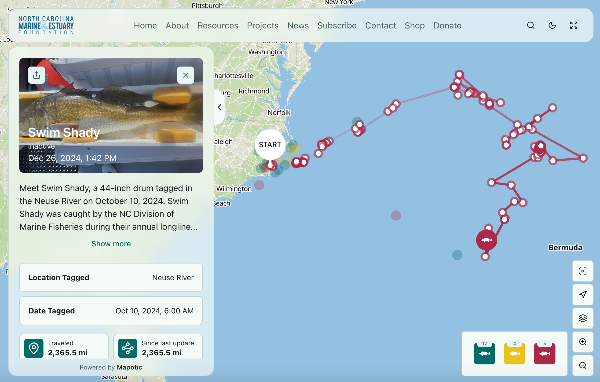 This unusual pattern led our team to wonder whether something larger might have been involved. Could Swim Shady have been consumed by a shark? And if so, could a satellite tag continue transmitting data from inside a shark's stomach?
To explore these questions, we turned to Chelsea Black, PhD, a Postdoctoral Research Fellow at the UNC Chapel Hill Institute of Marine Sciences who specializes in shark research. With extensive experience using satellite tags, Chelsea was well-equipped to test this theory.
Our team provided Chelsea with the same satellite tags used in our red drum study. She conducted a controlled experiment, placing one tag outside a shark and another inside a shark's stomach. Both tags transmitted signals during the test, demonstrating that satellite tags can continue pinging even after being ingested. While we cannot say with certainty what happened to Swim Shady, the movement pattern and tag behavior are consistent with scenarios observed when tagged fish are consumed by large predators such as sharks.