
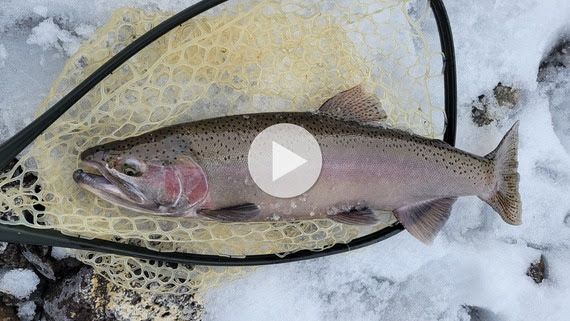
The California Department of Fish and Wildlife (CDFW) this spring conducted the largest rescue of Eagle Lake rainbow trout in more than a decade, returning approximately 5,800 adult fish to Eagle Lake that were at risk of becoming stranded in the lake's main tributary, Pine Creek.
The emergency efforts occurred over four days in March and April and involved more than 25 CDFW biologists, hatchery staff and several community volunteers.
"These fish are long-lived so there's a very good chance that fish returned to the lake could return in subsequent years to spawn again," said Paul Divine, CDFW's District Fisheries Biologist for Lassen and Modoc counties. "And it's also putting adult-sized fish back in the lake that could be enjoyed by anglers to catch as well."
Eagle Lake opens to trout fishing on Saturday, May 23 with a two-fish daily limit and a four-fish possession limit. Eagle Lake rainbow trout are endemic to Eagle Lake and its main tributary, Pine Creek. Catching an Eagle Lake rainbow trout within Eagle Lake qualifies toward CDFW's Heritage Trout Challenge. Anglers can report their angling experience at CDFW's California Inland Recreational Angler Survey (CIRAS).
Eagle Lake rainbow trout play a significant role in CDFW's trout hatchery operations as the popular sport fish are stocked far and wide for recreational fishing in waters across the state ranging from Lake Annie in Modoc County to Cuyamaca Lake in San Diego County.
Prior to the fish rescue, CDFW was able to meet its spawning goals, collecting 1.3 million fertilized eggs from 320 pairs of Eagle Lake rainbow trout. About 170,000 of those offspring will be returned to Eagle Lake to support the fishery.
Fish strandings are not a new phenomenon at Pine Creek. CDFW records document periodic rescues dating back to 1959. The lower 25 miles of Pine Creek is seasonal and completely dependent on snowmelt for its flows.
Unseasonably warm weather this past February and March accelerated runoff and Pine Creek flows into Eagle Lake, triggering an early spawning run among the rainbow trout. Overall snowpack levels were low, however, and diminished quickly in the warm weather, potentially stranding thousands of trout within Pine Creek's deeper pools and forcing CDFW to mobilize the largest emergency trout rescue there in more than a decade. The fish were collected using backpack electrofishing units, block nets and dip nets. The fish ranged in size from 9 to 24 inches, some weighing 4 to 5 pounds.
"Pine Creek has always been unpredictable, but we're seeing more extremes over the last 10 years," said Divine, who has managed the Eagle Lake fishery and overseen spawning operations there for nearly 20 years.
Pine Creek's flows have dried up three times in the last 10 years, preventing Eagle Lake's rainbow trout from accessing their primary spawning and rearing grounds altogether. CDFW's spawning operations conducted this past March were the earliest to occur in 40 years.
Persons with disabilities needing reasonable accommodation to participate in public meetings or other CDFW activities are invited to contact CDFW's Accessibility Coordinator in the CRO Office at (916) 902-5577, or send an email to CivilRights@wildlife.ca.gov. Reasonable Accommodation requests for facility and/or meeting accessibility should be received at least 21 days prior to the event. Requests for American Sign Language Interpreters should be submitted at least two weeks prior to the event, and requests for Real-Time Captioning at least four weeks prior to the event. These timeframes are to help ensure that the requested accommodation is met. If a request for an accommodation has been submitted but due to circumstances is no longer needed, please contact the Accessibility Coordinator immediately.