
DEC Region 6 Fisheries, in partnership with the U.S. Fish and Wildlife Service (USFWS), is conducting a walleye acoustic telemetry study to better understand walleye populations in the St. Lawrence River and the Eastern Basin of Lake Ontario. The study is designed to assess walleye movement, relative use of important spawning sites, and determine how different spawning populations mix within the system. This information is important for informed management and habitat restoration decisions needed to protect and enhance this critical fishery.
Beginning in 2022, spawning walleye were collected from select tributaries and surgically implanted with internal tags that are detected by acoustic receivers deployed throughout the river and lake bottom. Each walleye also has a visible Floy® tag identifying it as a study fish (pictured below). With help from volunteer anglers, DEC and USFWS recently began the second phase of the study to focus on tagged St. Lawrence River mainstem shoal-spawning walleye.
What To Do If You Catch a Tagged Walleye
If you catch a tagged fish, you are not required to release it, but we strongly encourage it so we can continue to learn about that fish's movement. Releasing it allows the fish to remain part of the ongoing research project as the tags have a ten-year battery life. If you catch and/or harvest a tagged walleye, please report the tag number and capture location to the USFWS at 607-753-9334. We appreciate your assistance!
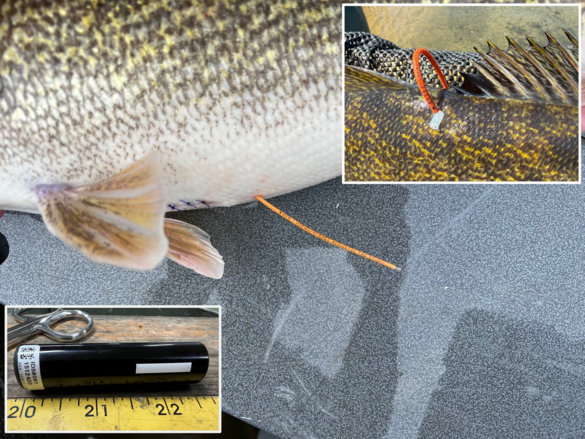
Walleye with an implanted transmitter tag sticking out at bottom of fish near the pectoral fins and loop tag near the dorsal/back fin (top right photo). The transmitter (bottom left photo) is implanted in the fish and detected by receivers placed throughout the bottom of the river and lake so biologists can better track their movement and spawning sites.