
Red drum hold a special place along the Atlantic coast. They are North Carolina's official state saltwater fish, a signature species of southeastern estuaries, and one of the most pursued gamefish from the Outer Banks to the Florida Keys. For coastal anglers and the communities that depend on them, few species carry more cultural and economic significance.
Red drum are managed as two separate populations divided by an informal but meaningful boundary at the North Carolina-South Carolina state line. The northern stock encompasses North Carolina and Virginia, while the southern stock includes South Carolina, Georgia, and Florida. Each faces different environmental conditions, fishing pressures, and management challenges.
In 2024, the Atlantic States Marine Fisheries Commission completed a benchmark stock assessment concluding that the southern red drum population had declined to levels requiring harvest reductions to support rebuilding. South Carolina's Department of Natural Resources later conducted its own independent assessment and reached a similar conclusion. Two separate analyses pointed to the same reality: fishing pressure has steadily increased over the past quarter century, and without intervention, rebuilding a long-lived species such as red drum could take decades.
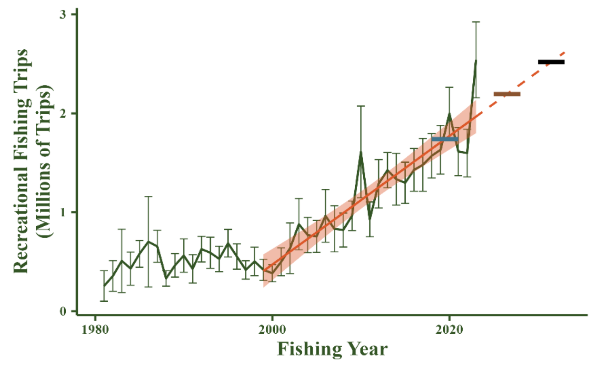
Source: South Carolina Department of Natural Resources Red Drum Stock Assessment
This is not the first time managers have faced such a challenge. The southern red drum fishery declined sharply in the late 1980s, prompting coordinated conservation measures across the region. Those actions ultimately succeeded, demonstrating that science-based management can reverse downward trends when applied early and consistently.
South Carolina lawmakers and fisheries managers have now taken another significant step. Beginning July 1, 2026, the daily red drum creel limit will drop from two fish to one, and the boat limit will fall from six fish to two. The harvest slot will shift from 15-23 inches to 18-25 inches, protecting more juvenile fish while still allowing anglers to keep slightly larger fish.
Anglers using natural bait and hooks sized 4/0 or larger to target gamefish such as red drum, cobia, and tarpon will also be required to use non-offset, non-stainless circle hooks. Circle hooks are widely recognized for reducing deep-hooking injuries and improving post-release survival, making this change as important for released fish as those brought home.
These regulations mark the first phase of a long-term rebuilding effort. The question now is how far the southern red drum population has declined, and what success will ultimately look like. One way to answer that question is through FINDEX, the North Carolina Marine & Estuary Foundation's fisheries status index, which provides a broader view of where the stock stands today and how it has changed over time.
South Carolina's new red drum regulations were adopted in response to a clear scientific finding: the southern stock has declined and will require time and management action to rebuild. But how large is that decline, and how does today's fishery compare to the population anglers enjoyed a generation ago? To help answer those questions, we applied our FINDEX framework to South Carolina's red drum assessment data.
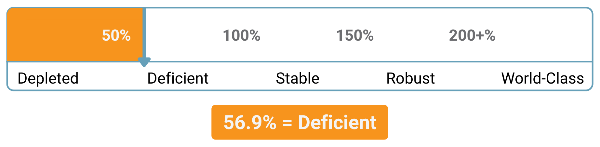
Launched in 2022, FINDEX translates complex stock assessment data into a simple percentage score that reflects how closely a fish population aligns with established biological targets. Scores fall into five categories: Depleted, Deficient, Stable, Robust, and World-Class.
Until now, FINDEX has been applied exclusively to North Carolina fisheries. South Carolina red drum provided an excellent opportunity to examine a neighboring fishery through the same lens. The result: based on the most recent assessment data, South Carolina's red drum fishery scores 56.9% on the FINDEX scale, placing it in the Deficient category. That score reflects point estimates of fishing mortality and spawning stock biomass relative to their biological targets, and closing that gap is precisely what the new regulations are intended to accomplish.
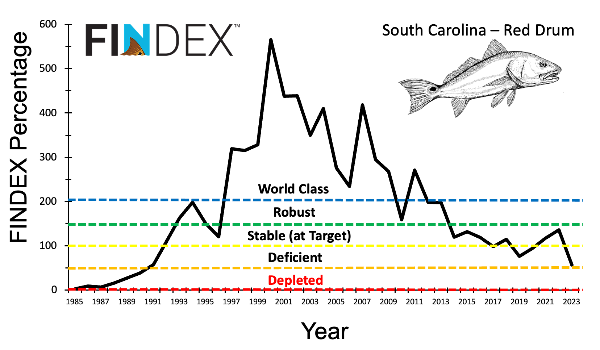
The historical trend may be even more informative. From 1997 through 2013, South Carolina's red drum population consistently achieved World-Class status on the FINDEX scale, one of the strongest periods in the fishery's modern history. The decline that followed was not abrupt; it unfolded gradually over more than a decade, alongside steadily increasing fishing effort. Viewed through the FINDEX framework, the progression is both measurable and unmistakable.
Why should anglers in North Carolina pay attention? For starters, many of our readers fish South Carolina waters too, and these regulations take effect in less than two weeks. More importantly, ongoing research continues to examine the relationship between the northern and southern red drum stocks and what that connection may mean for fisheries management across the region.
The encouraging news: steps are now in place to address the decline. The science identifies a clear path forward, and the new regulations provide the tools needed to support rebuilding. The years ahead will reveal whether these measures are enough to return South Carolina's red drum fishery to the World-Class status it once enjoyed.
Visit FINDEX to explore and track the status of North Carolina's coastal fisheries.