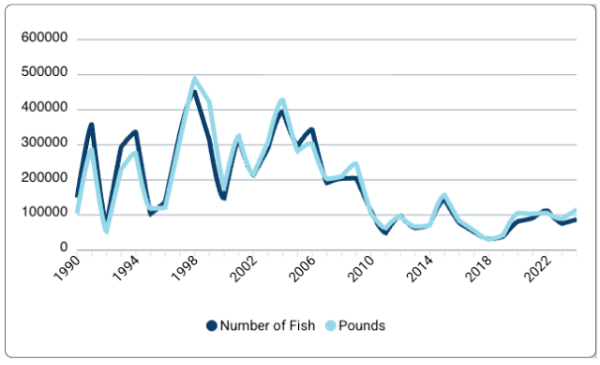
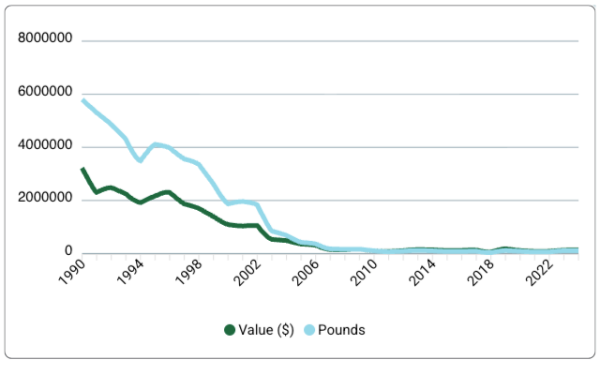
There was a time when a summer evening on a North Carolina sound meant one thing: gray trout on the line. Weakfish, whose proper name was earned not from any lack of fight but from the fragile tissue around their mouths that lets hooks tear free, were once the pulse of the inshore fishery here. In 1987, recreational anglers landed over 2.4 million of them, totaling 3.4 million pounds. Commercial boats were hauling in even more, with over 15 million pounds in 1988 alone.
By 2024, the combined commercial and recreational total had fallen to roughly 222,000 pounds. That's a decline of more than 98 percent in three decades. The fish are still out there, but just barely, at least by historical measures. If weakfish feel like a ghost of the North Carolina coast, that's because they are in population terms.
Recreational Trends
Commercial Trends
Weakfish are members of the drum family, close cousins of spotted seatrout but with a taste for the higher-salinity waters near coastal inlets. They spawn in our sounds and estuaries each spring and mature quickly, making them a species capable of rapid growth under favorable conditions.
The stock collapse of weakfish was not sudden. Landings slid through the 1990s and continued falling through the 2000s. By 2009, a coastwide stock assessment declared weakfish severely depleted. In response, fishery managers implemented emergency harvest restrictions that remain in effect today: one fish per person per day for recreational anglers and a 100-pound daily trip limit for commercial fishermen. Against the backdrop of what the fishery once produced, those limits tell a sobering story.
What makes weakfish unusual is that overfishing is not the primary cause of the decline. The 2016 benchmark assessment, along with its 2019 update, found that natural mortality has increased dramatically, climbing fivefold between the early part of the study period and the 2007–2017 window. Shifting predator communities, changing forage availability, and other ecological pressures were taking weakfish at rates far exceeding what the population had historically experienced, even as fishing pressure dropped to low levels. State biologists managing the population can tighten harvest restrictions, but they cannot reduce predation from striped bass, bluefish, or dolphin. That reality makes weakfish one of the more humbling cases in coastal fisheries management. Managers did largely what they were supposed to do, but the fish kept dying.
The leading explanation is a cascade of ecosystem change. The rebound of striped bass along the Atlantic coast in the 1990s and 2000s may have placed weakfish under sustained predation pressure that a diminished population simply cannot absorb. But the picture refuses to simplify neatly. Striped bass are now declining coastwide, yet weakfish natural mortality remains elevated. Multiple predators, a shifting forage base, and broader ecosystem dynamics all appear to be at work. As it turns out, marine ecosystems do not sort themselves out one species at a time.
Echoes in the Data — And Reasons to Keep Watching
The toll from decades of elevated natural mortality is evident in the age structure of the population. Historically, weakfish in North Carolina waters were sampled as old as 15 years. Since 2007, the oldest fish state biologists have recorded has rarely exceeded age six. The population has lost many of its oldest and most reproductively powerful fish. While female weakfish mature early, older fish spawn more frequently and produce far more eggs. A population skewed entirely toward young fish is a population that cannot easily rebuild itself.
And yet, the data carries a few notes worth hearing. In 2023, the Pamlico Sound Survey recorded its strongest juvenile weakfish abundance in a decade, a genuine pulse of young-of-the-year fish that biologists watch closely as a leading indicator of future stock condition. Then, the 2024 numbers pulled back, a reminder that one strong year is not a trend. But recreational harvest reached 115,496 pounds in 2024, the highest level since 2015. The NC Saltwater Fishing Tournament issued 30 weakfish citations in 2024, down from a high of 59 in 2022 but well above the near-zero totals that defined most of the 2010s. At a minimum, that data suggests change is occurring.
None of this means recovery is underway. The breeding population remains far below the thresholds that would indicate a sustainable fishery, and the ecosystem pressures driving elevated natural mortality have not been resolved. A 2025 coastwide assessment update, the first since 2019, was not accepted for management use, highlighting how difficult it is to model a species whose fate is driven largely by forces beyond the reach of traditional fishery regulations. A new benchmark assessment is being prepared this year.
Our FINDEX platform currently scores weakfish at 22%, earning a "depleted" designation that reflects low spawning stock biomass and elevated total mortality relative to management targets. For context, weakfish reached "world-class" status on that same scale in the mid-to-late 1990s, with a peak score above 400% in 1997. The distance between then and now is the story of this fishery.

Few species better illustrate the complexity of modern fisheries management than weakfish. Once abundant across North Carolina's estuaries and sounds, the population remains a fraction of what it once was, and the reasons are more complex than harvest alone. Understanding those drivers will require continued investment in science through better quantification of natural mortality, more sophisticated ecosystem modeling, and long-term monitoring that can separate temporary fluctuations from meaningful recovery. Our Foundation is committed to supporting that work to help ensure that the science needed to understand weakfish recovery remains a priority.