
STANWOOD – One of Washington's largest salmon habitat restoration projects to date broke ground this week on two islands in the South Fork Skagit River estuary in Skagit County.
Over the next two years, the Washington Department of Fish and Wildlife (WDFW)'s Island Unit Restoration Project will restore 270 acres on the Skagit Wildlife Area to natural intertidal estuary and marsh habitat, benefiting Endangered Species Act (ESA)-listed Puget Sound Chinook salmon as well as many other species of fish and wildlife.
"This project doesn't just restore habitat on this 270-acre site; it removes barriers to reconnect hundreds more acres of intertidal estuary across the South Fork Skagit River delta," said Jenny Baker, project manager and a WDFW senior restoration specialist. "Young Chinook will quickly use these rich feeding grounds so that they grow bigger and survive better once they leave the shelter of the estuary and head out into Whidbey Basin, Puget Sound, and the ocean beyond."
The Island Unit of Skagit Wildlife Area will be closed to the public from July 2026 through fall 2028. The boat launch parking lot and boat launch on the neighboring Skagit Headquarters Unit will be periodically closed as construction supplies and equipment are deployed to the island.
The Island Unit is only accessible by boat and is popular for waterfowl hunting. Kayakers, boaters, photographers, and wildlife watchers also visit the site. Historically, the area was a tidally influenced estuary that provided important rearing habitat for juvenile Chinook. It was diked in the early 1900s to support agriculture and later acquired by WDFW in the 1950s.
"Through years of collaboration with treaty tribes, advisory group members, waterfowl hunters, and partner organizations, we're proud of how this project balances habitat restoration for Chinook salmon recovery with continued recreational access for hunting, boating, paddling, and wildlife watching," said Brendan Brokes, WDFW'S North Puget Sound Regional Director.
The habitat project will include removing dikes, levees, and tidegates to restore the natural flow of water from Skagit Bay and the Skagit River's Freshwater, Deepwater, and Steamboat sloughs, as well as excavating channels into the interior of the unit and constructing low angle landings, fords, and recreational mounds.
The low angle landings are unimproved landings where small boats can more easily beach; whether for recreational access such as paddling and waterfowl hunting, or for weed control and land maintenance. Recreational mounds will feature areas that remain dry through much of the tidal cycle and include shrubs and trees for wildlife habitat diversity. Following the restoration project's completion, WDFW will install waterfowl hunting blinds on some recreational mounds overlooking areas that hold water longer through the tide cycle.
A map showing the final project design is available on WDFW's website.
WDFW proposed the project in the late 2010s, and tribal consultation, community, advisory group, and public input began in 2020, including several rounds of stakeholder meetings and formal public comment. Brumfield Construction, Inc. of Aberdeen will lead construction. For more background information including on project alternatives and timelines, refer to WDFW's project webpage.
Funding for construction of the Island Unit Restoration Project comes from the federal Bi-Partisan Infrastructure Law and/or the Inflation Reduction Act (IRA) through the National Oceanic and Atmospheric Administration (NOAA), the Puget Sound Acquisition and Restoration Fund, and Washington's Climate Commitment Act (CCA). The CCA supports Washington's climate action efforts by putting cap-and-invest dollars to work reducing climate pollution, creating jobs, and improving public health. Information about the CCA is available at www.climate.wa.gov.
Funding for project planning, design, alternatives analysis, and permitting also comes from Washington state's operating and capital budgets through WDFW, the Washington Salmon Recovery Funding Board, and the Estuary and Salmon Restoration Program (ESRP).
The Island Unit project builds on the success of WDFW's neighboring Milltown Island Estuary Restoration Project, where construction was completed in late 2024 and restoration planting is ongoing.
Estuaries are areas of marsh and wetland surrounding the intertidal zone where freshwater rivers and sloughs meet saltwater. Estuaries are home to many diverse fish and wildlife species. They are particularly important for juvenile Chinook salmon, known as smolts, as they rear and grow larger during their migration to the ocean. More information on estuary restoration is available on WDFW's Puget Sound recovery webpage.
WDFW manages more than a million acres of land and hundreds of water access areas throughout the state. By actively managing lands, restoring habitats, and preserving wild places, the Department serves as stewards for Washington's natural ecosystems, protecting the state's land and water for its fish, wildlife, and people.
The Washington Department of Fish and Wildlife works to preserve, protect and perpetuate fish, wildlife and ecosystems while providing sustainable fish and wildlife recreational and commercial opportunities.
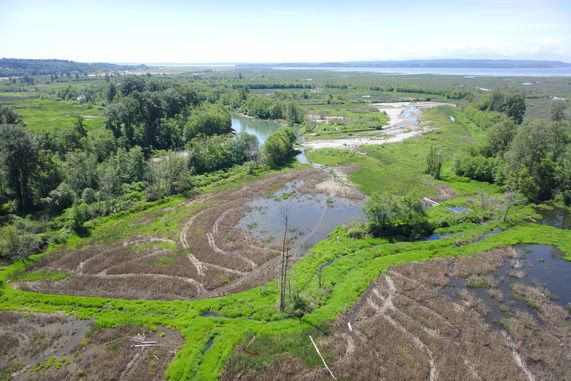
A photo of the Island Unit of Skagit Wildlife Area looking southwest towards Skagit Bay prior to restoration project construction in May 2026.