
From Assessment to Answer: FINDEX
Stock assessments were designed for scientists and fishery managers. For everyone else, they can be difficult to interpret. Take the terms overfished and overfishing. They have precise scientific definitions, yet they're often misunderstood. When people hear that a fish population is overfished, many assume fishermen are currently catching too many fish. When they hear overfishing is occurring, they often assume the population has already collapsed. In reality, neither conclusion is necessarily true. The terminology is scientifically accurate, but it isn't always intuitive.
Imagine bringing home a report card that simply said "passing" or "failing," with no grades attached. Most parents would want to know much more. Was the student barely passing or earning straight A's? Our fisheries deserve that same clarity. That's exactly why we created FINDEX®.
Several years ago, our Foundation asked a simple question: If a stock assessment tells us how a fish population is doing, why shouldn't everyone be able to understand the answer? That question became the springboard for our fisheries status index, which builds upon stock assessments rather than replacing them. Every FINDEX score begins with the same science used by fisheries managers, then translates those findings into a format anyone can grasp.
Rather than asking readers to interpret technical measures such as spawning stock biomass or fishing mortality, FINDEX compares each species against the biological targets established through the stock assessment process and reports the result as a simple percentage. Instead of wondering whether a fish population is "overfished," readers can immediately see how close that population is to where science says it should be. Whether the answer is 42 percent, 87 percent, or 118 percent, the meaning is instantly clear.
Traditional fisheries management is built around minimum standards. Is the stock overfished? Is overfishing occurring? Those questions are essential because they help prevent collapse, but they don't tell us what exceptional looks like. FINDEX asks a different question: What would it take to build world-class fisheries?
Perhaps most importantly, FINDEX defines what "world-class" actually means. The phrase is often used to describe exceptional fisheries, but it's rarely measured. FINDEX sets that benchmark by identifying fish populations that exceed their biological targets by more than 200 percent. It transforms "world-class" from an aspiration into a measurable standard, while recognizing every stage of progress along the way, from Depleted to Rebuilding, Stable, Robust, and ultimately World-Class.
Our goal wasn't to simplify the science. It was to simplify the conversation. For decades, fisheries science has been exceptionally good at identifying when populations fall below acceptable limits. FINDEX complements that science by measuring something equally important: how close we are to achieving the full potential of our fisheries. Good decisions begin with good information. Stock assessments provide the science, and FINDEX makes it understandable. Instead of asking whether a fish population has avoided failure, FINDEX asks how close it is to achieving excellence.
How Does Your Favorite Fish Stack Up?
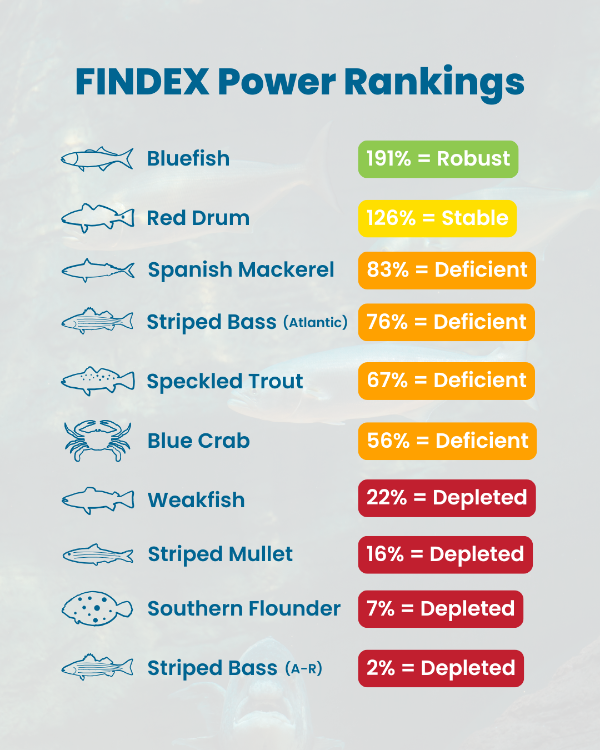
Now that you know how stock assessments work and why FINDEX came about, here's how some of North Carolina's most important species stack up.
Bluefish leads the pack at a Robust FINDEX value of 191 percent, while the beloved red drum holds steady at Stable. On the other end, species like Southern flounder and Albemarle-Roanoke striped bass remain Depleted, a reminder of how much work is still ahead.
Science got us here. Now it's up to smart management to move more of these species toward World-Class. Visit FINDEX to dive deeper into each species profile.