Red Drum Scoping Information
As part of a five-year review of North Carolina's Red Drum Fishery Management Plan (FMP), the Division of Marine Fisheries (DMF) is taking a closer look at the fishery and asking fishermen and other interested members of the public to share what they're seeing on the water and what they think should be considered.
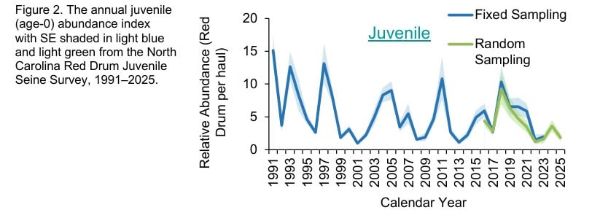
The latest stock assessment found that the northern Red Drum stock, which includes New Jersey through North Carolina, is not overfished and is not experiencing overfishing. However, North Carolina fishery-independent data show declining Red Drum abundance, while fishing effort and harvest have increased in other areas of the stock's range.
Red Drum in North Carolina are jointly managed under Amendment 1 to the North Carolina Red Drum FMP and the Atlantic States Marine Fisheries Commission's (ASMFC) Addendum II to Amendment 2 to the Interstate FMP for Red Drum. The current ASMFC FMP for Red Drum requires states to implement recreational creel and size limits to achieve the fishing mortality target (F40%), including a maximum size limit of 27 inches TL, and maintaining existing commercial regulations.
Specific management options have not been developed by DMF at this time. After reviewing public comments received during the scoping process, the DMF will recommend whether to pursue an Information Update, where no management changes are made, or an Amendment, where management changes are proposed for adoption by the Marine Fisheries Commission (MFC). During the FMP review, only management strategies that maintain compliance with the ASMFC requirements for Red Drum will be considered.
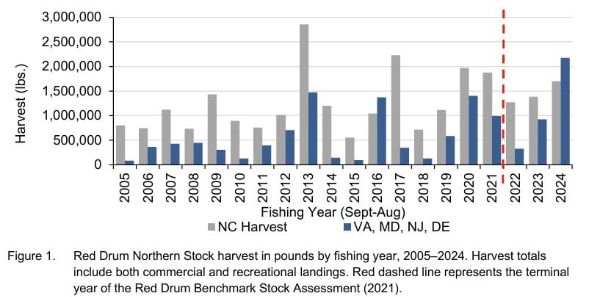
The most recent stock assessment, approved by the ASMFC for management use in October 2024, found the Northern Stock is not overfished and is not experiencing overfishing. The Northern Stock was evaluated using a Traffic Light Analysis (TLA), which relies heavily on the long-term data collected by North Carolina (2024 Benchmark Red Drum Stock Assessment). Despite the positive stock status determination for the Northern Stock in the last year of the assessment (2021), fishing mortality rates have been increasing and are approaching the fishing mortality threshold. The ASMFC stock assessment noted that the increase in fishing mortality during the terminal years of the assessment was likely driven by increased Red Drum harvest in Virginia and Maryland.
Harvest pressure is clearly increasing on the Northern Stock of red drum from both commercial and recreational fishermen. With warming waters pushing fish to our north, Virginia (and the states to their north) recorded total harvest in 2024 that surpassed NC total harvest for the first time in history.
Since the Southern flounder harvest restrictions were put in place in 2019, the average commercial harvest in NC has increased to a relatively steady level at around 200,000 pounds annually. Examining the average commercial harvest prior to 2019 over the same interval from 1991- 2019, an increase is clearly noticeable in recent years. The total reported commercial harvest does fall below the cap, but the noticeable increase in average harvest since the 2019 Southern flounder restrictions were put in place does raise the question - are commercial fishermen now targeting red drum to make up for losses in other fisheries? Commercial harvest is supposed to be a bycatch only fishery, currently regulated at 7 fish per day to control the high regulatory discard mortality in the anchored large mesh gill net fishery that is primarily used in the Southern flounder fishery. Since that aspect of the fishery has been reduced to a maximum of a few days, the question should be asked if this allowance is still necessary.
During the October 1 - 30, 2026 scoping period, DMF is asking the public to tell them what you are seeing and share your ideas about how Red Drum should be managed. Your input will help DMF determine whether management changes should be considered.
If changes are needed, DMF will develop a proposed amendment to the Fishery Management Plan. If no changes are needed, DMF will develop an information update to maintain current management.
You can review the information online at the DMF website and submit your comments by October 30.